Carbon Brief · Klimaat
Land-use emissions have decreased by a third this century, driven by reduced deforestation and increased forest regrowth.
Emissions from land-use change, including deforestation and peatland degradation, have significantly declined in the 21st century, according to the Global Carbon Budget report. This decrease has helped to offset the continuous rise in fossil-fuel emissions.
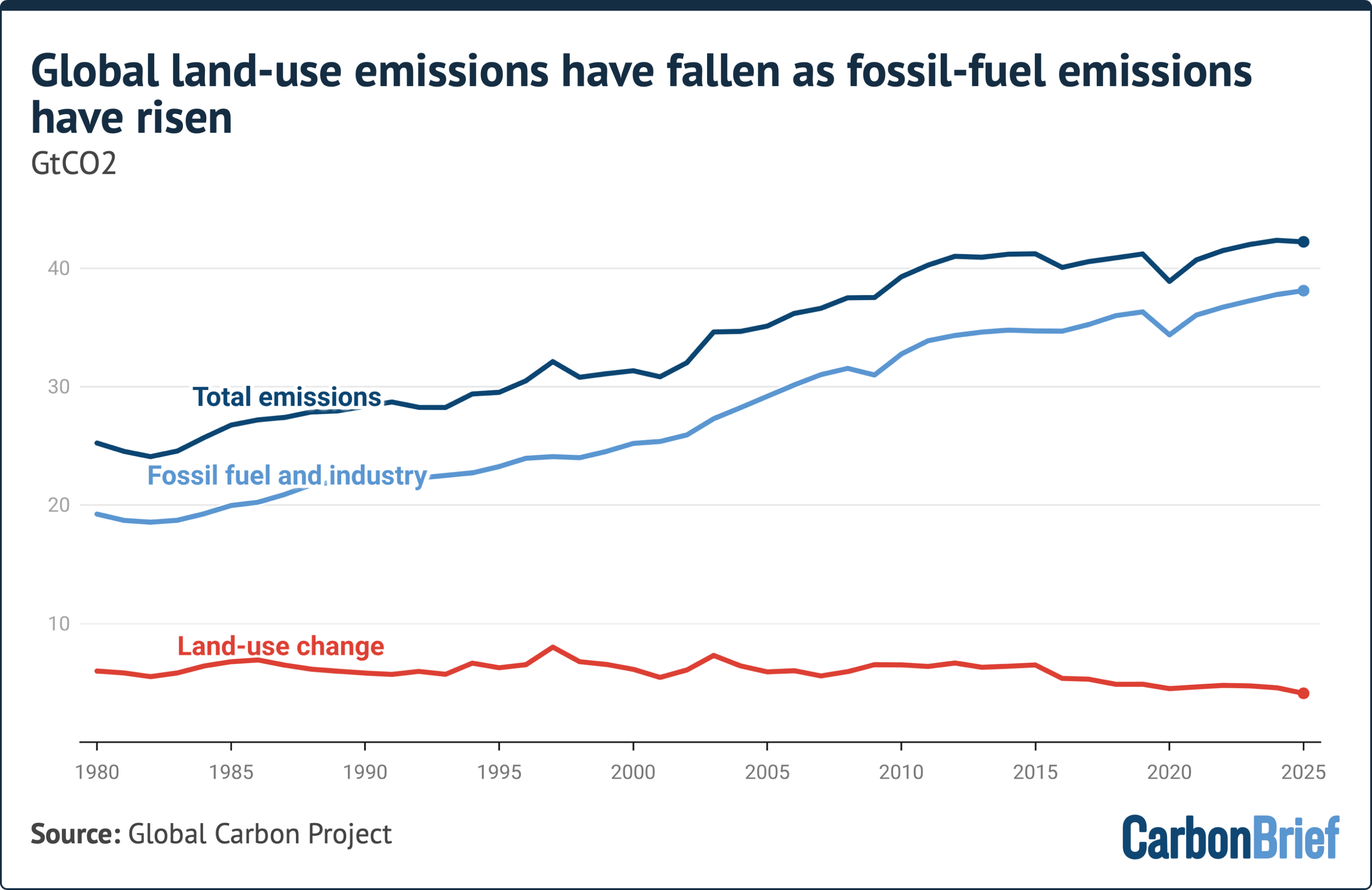
Global land-use emissions, which encompass deforestation, forest degradation, and peatland loss, have seen a notable decrease since the late 1990s, with a particularly sharp drop observed after 2015. The Global Carbon Budget report estimates a 32% reduction in land-use emissions in 2025 compared to the 2000s average. This trend contrasts with the steady increase in emissions from fossil fuels and cement production over the same period.
The primary drivers behind this decline are a reduction in permanent deforestation and an increase in carbon dioxide removals from forest regrowth. While deforestation, such as the clearing of forests for agriculture or urban development, releases carbon, forest regrowth, including afforestation and reforestation efforts, sequesters it. Over 2015-2024, carbon removals from forest growth offset two-thirds of deforestation emissions.
Brazil and Indonesia have been key contributors to the decrease in land-use emissions, largely due to forest protection policies and international trade regulations that have curbed deforestation. China, the EU, and the US are leading in carbon sequestration through reforestation and afforestation. However, the Democratic Republic of the Congo (DRC) presents a different picture, with emissions remaining high due to population growth and expanding subsistence farming, as international regulations have had less impact there.
Estimating land-use emissions is complex, with an uncertainty range of over 50% for the 2015-2024 average. This complexity arises from the difficulty in distinguishing between human-caused emissions and those from natural factors, as well as differing methodologies in land-use models. Projections for recent years rely on proxies due to the unavailability of complete land-use statistics.
AI-samenvatting op basis van de bron.
Carbon Brief