Our World in Data · Mens en maatschappij
Which countries have already passed peak population, and when will the rest do so?
Many countries are experiencing structural population decline due to falling birth rates, a phenomenon not seen before in history outside of temporary shocks like war or famine. The United Nations' projections indicate that 64 countries and territories had already passed their peak population by 2026, primarily in Europe and East Asia, with some in Southeast Asia and South America also showing this trend.
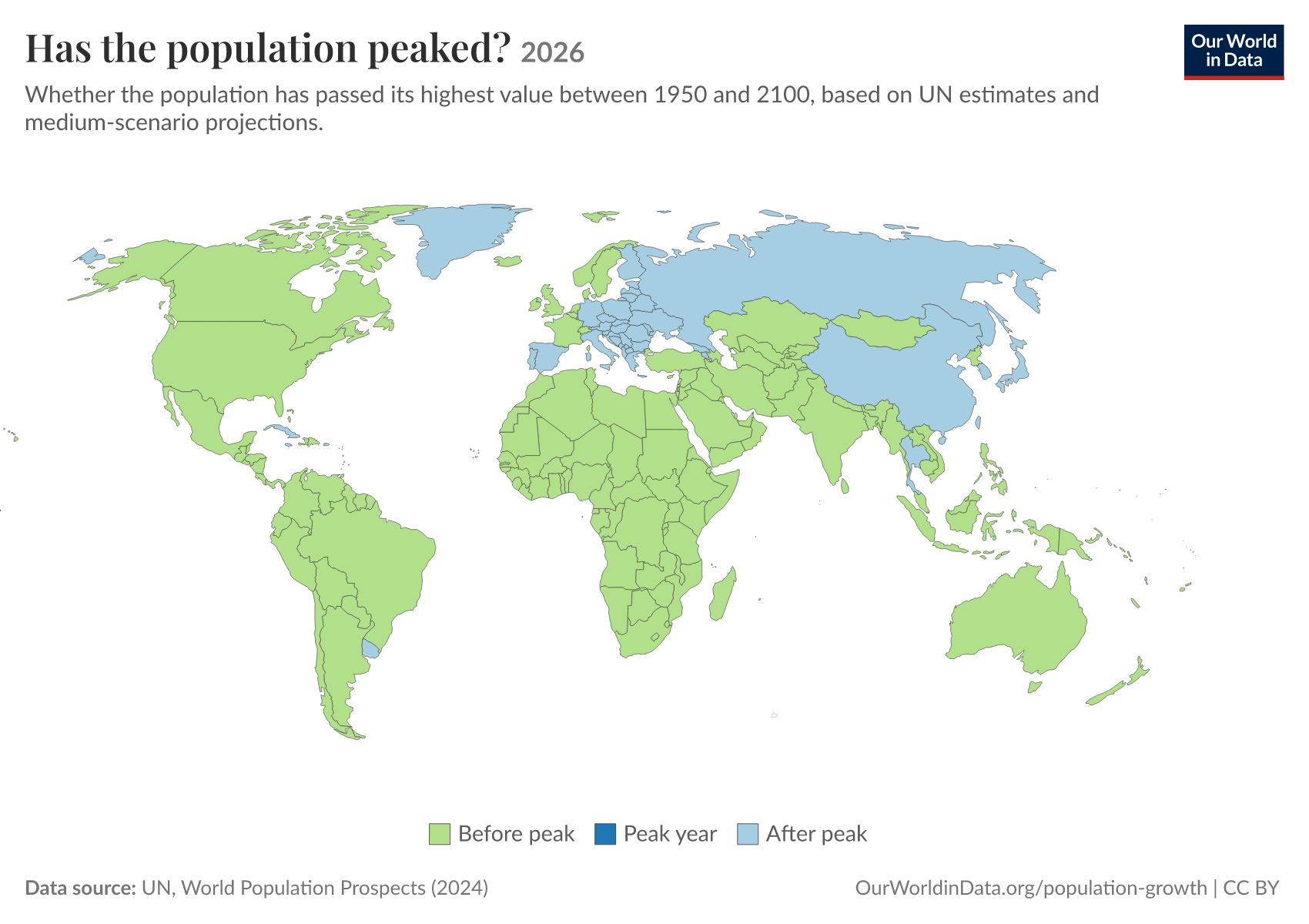
These countries, predominantly in Europe and East Asia, have seen rapid reductions in fertility rates and persistently low rates. Emigration has further contributed to population decline in many Eastern European nations. Surprisingly, countries like Thailand and Uruguay have also experienced significant drops in fertility rates, falling below replacement levels.
While many nations have only recently passed their peak, some, including Japan and Italy, did so over a decade ago. Projections suggest substantial population shrinkage by the end of the century for countries like South Korea and China (potentially halving), Italy (over 40% reduction), and Spain and Thailand (a third).
More countries are expected to follow suit in the coming decades. By the 2050s, much of South America is projected to peak, followed by South Asia, including India, by the 2060s.
These population peak projections are based on the UN's medium variant, which considers fertility rates, life expectancy, and migration. However, these factors are difficult to predict long-term. Migration rates, in particular, can significantly alter these projections; many high-income countries currently maintain stable or growing populations due to immigration.
For instance, the United States' population is projected to continue growing due to immigration offsetting low birth rates. Without immigration, the US population would peak soon and shrink by 60 million by 2100, resulting in a population 130 million smaller than projected with migration.
The timing of population peaks for some countries is highly sensitive to assumptions about future migration, fertility, and longevity. For others, like South Korea, a shrinking population appears inevitable, with the necessary changes in these factors to reverse the trend seeming implausible.
AI-samenvatting op basis van de bron.
Our World in Data