designboom · Creativity & design
Le Corbusier's Paris Plan vs. Chtcheglov's Urban Drift
Two contrasting urban planning philosophies are explored: Le Corbusier's highly organized 'Plan Voisin' for Paris and Ivan Chtcheglov's 'Formulary for a New Urbanism' which emphasizes aimless wandering.
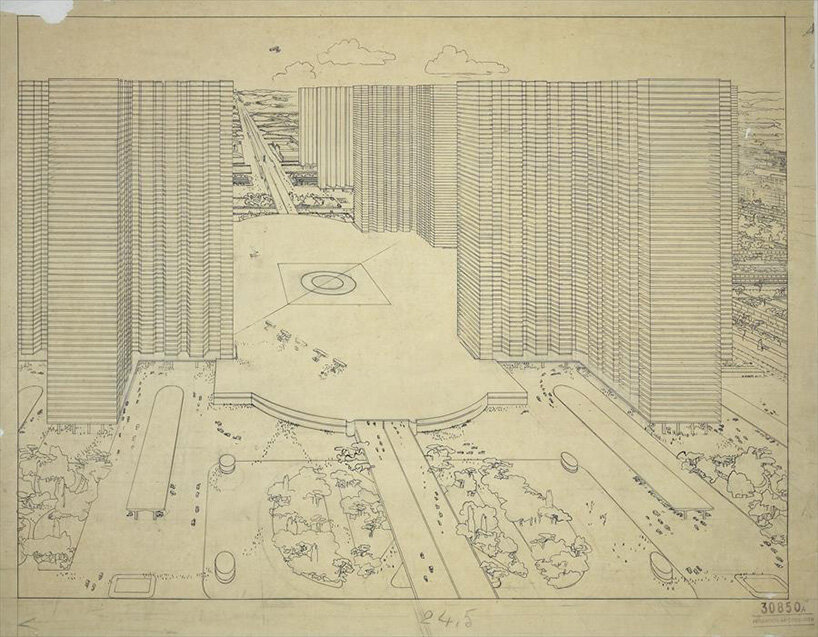
Le Corbusier's 1925 Plan Voisin proposed a radical reorganization of central Paris, replacing existing structures with cruciform office towers and residential blocks to address congestion and poor sanitation. The plan aimed for a legible, functional city with separated zones, but it was never built, though its principles influenced modernist urbanism.
Decades later, Ivan Chtcheglov, writing as Gilles Ivain in 1953, criticized Le Corbusier's approach, viewing urban boredom as the primary issue. He advocated for 'new, changeable decors' and architecture that could alter moods and generate dreams, rather than functional, rigid structures.
Chtcheglov envisioned cities divided by feeling, with distinct Quarters for different emotions. He proposed architecture that could change appearance and incorporate nature, contrasting sharply with Le Corbusier's systematic, top-down design.
The Situationist concept of 'dérive' (drifting) aligns with Chtcheglov's ideas, where the experience of moving through the city, rather than reaching a destination, becomes paramount. This contrasts with Plan Voisin's emphasis on optimized, predetermined routes.
While Plan Voisin aimed to solve practical problems like overcrowding, Chtcheglov's philosophy values the unpredictable discoveries and subjective experiences that arise from detours and unexpected encounters in the urban environment.
Chtcheglov's city is designed around feelings and subjective experiences, valuing the 'long way' and the potential for 'total disorientation' over efficiency and convenience, a stark departure from Le Corbusier's rationalized urban system.
AI-samenvatting op basis van de bron.
designboom