Quanta Magazine · Science
Math's Langlands Program: A Unified Theory?
The Langlands program connects disparate mathematical fields, suggesting underlying unity. Its complexity makes it hard to grasp, even for mathematicians.
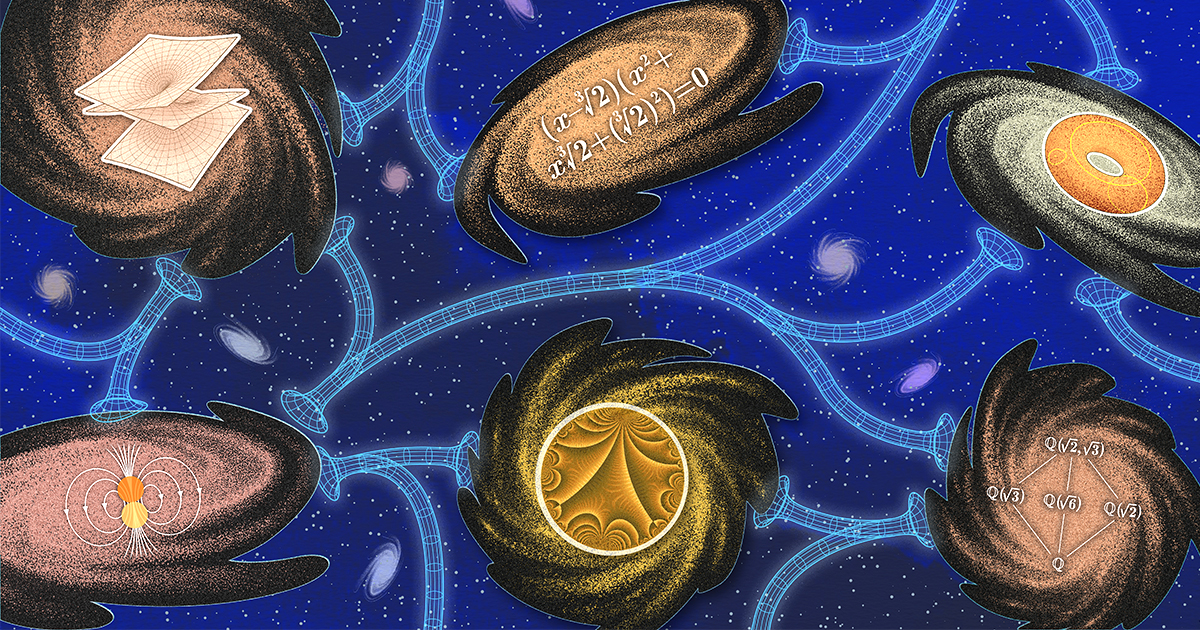
Initiated in 1967, it proposes correspondences between number theory and harmonic analysis, linking symmetries in number fields to properties of objects like modular forms.
Galois group symmetries of polynomial solutions generate data dictating modular form properties. Langlands generalized this to link Galois representations with automorphic forms.
The program enabled Andrew Wiles' proof of Fermat's Last Theorem by connecting it to the Taniyama-Shimura-Weil conjecture.
Correspondences extend to curves over finite fields and Riemann surface geometry, linking them to harmonic analysis.
Mathematicians prove specific cases, using insights from one area to advance another, but the meaning remains elusive.
It's seen as a non-abelian Fourier analysis, potentially revealing deeper mathematical organizing principles.
Physicists suggest dualities in quantum theories might explain these connections, hinting at an undiscovered underlying structure.
AI-samenvatting op basis van de bron.
Quanta Magazine