NASA · Space
Webb Telescope Identifies Host Galaxy of Most Distant Fast Radio Burst
Astronomers used the James Webb Space Telescope (JWST) to pinpoint the host galaxy of FRB 20240304B, the most distant fast radio burst (FRB) detected to date, offering new insights into their origins.
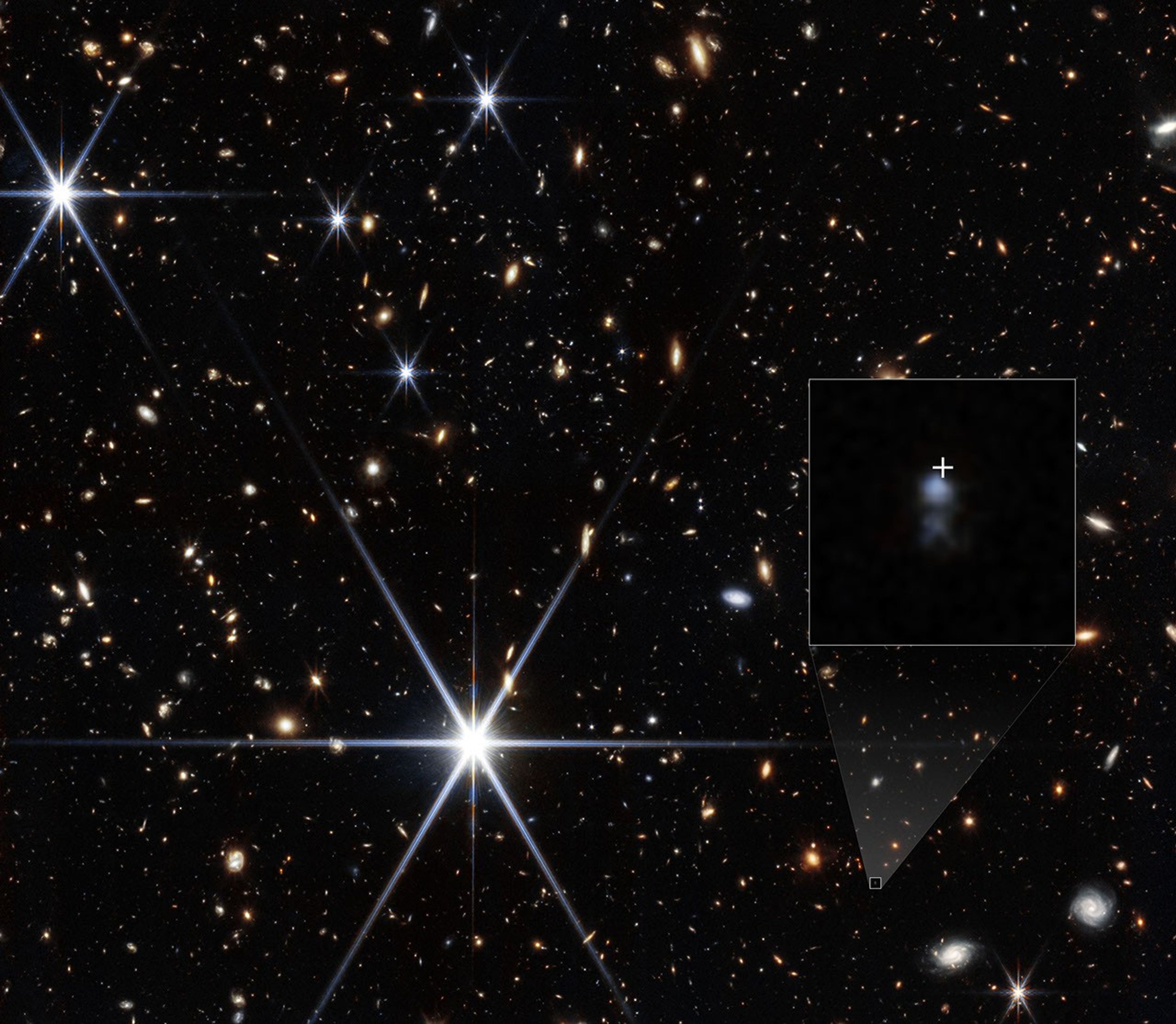
FRBs are millisecond-long radio flashes from deep space; their origin is uncertain. The MeerTRAP project detected FRB 20240304B, with initial data suggesting it was extremely distant.
JWST's NIRCam detected a faint galaxy at the FRB's location. NIRSpec measured a redshift of 2.148, indicating the burst occurred 3 billion years after the Big Bang.
The host galaxy is a small, star-forming dwarf galaxy, unlike most previously identified FRB hosts, which are more massive.
This galaxy existed during "cosmic noon," a period of peak star formation. Its rapid star formation suggests its stars formed within about 30 million years.
The galaxy's young, star-forming nature challenges theories linking FRBs to neutron star mergers, which require billions of years and older galaxies.
An alternative theory suggests FRBs originate from young magnetars shortly after their formation, aligning with the observed host galaxy.
The FRB signal also revealed intervening structures, including a galaxy cluster and the Virgo Cluster. Future JWST observations will study more distant FRBs.
AI-samenvatting op basis van de bron.
NASA