Quanta Magazine · Science
Sea Monkeys Help Scientists Reverse Energy Flow in Turbulence
Researchers have discovered that the orientation of brine shrimp (sea monkeys) can reverse the direction of energy flow in a two-dimensional turbulent system, challenging previous assumptions.
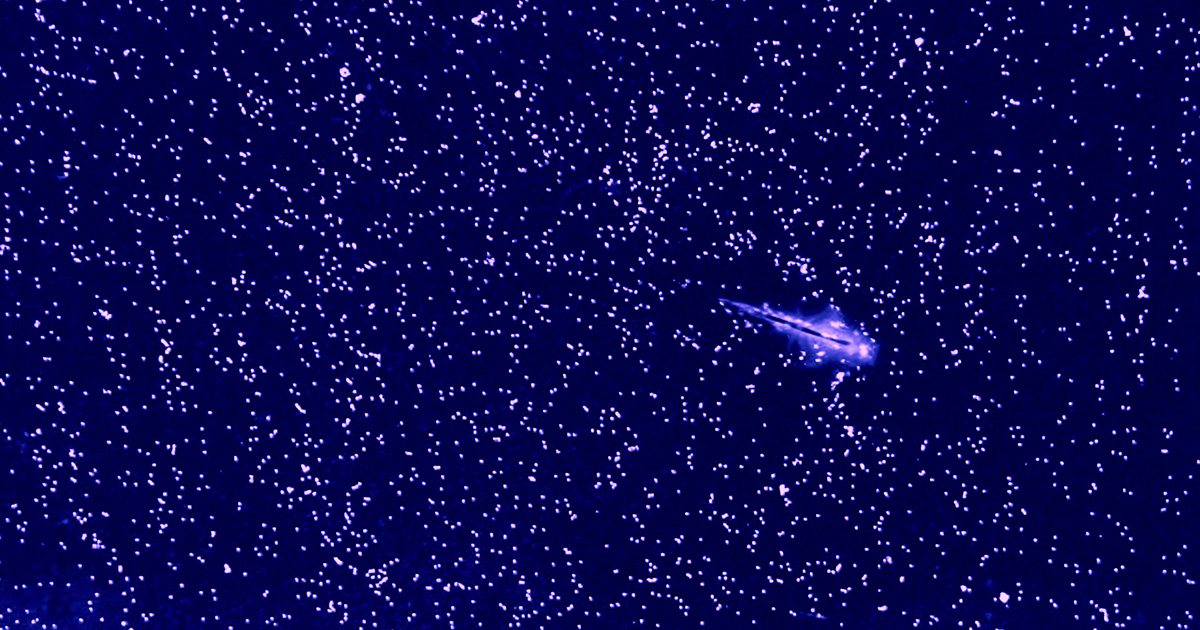
Scientists observed that by disrupting a fluid's flow with a small, angled obstacle, they could reverse the cascade of energy, a phenomenon previously thought to flow in only one direction.
This finding, based on the movement of brine shrimp, suggests that the geometry of disruptions is crucial in controlling energy flow within turbulent systems.
Turbulence, observed in everyday phenomena like waterfalls and flights, involves complex forces and energy transfer between different scales. Historically, it was understood that energy flows from larger to smaller scales or vice versa.
Pioneering work by Richardson and Kolmogorov focused on three-dimensional systems where energy moves from large to small eddies. Later, Kraichnan and Batchelor extended this to two-dimensional systems, noting an inverse energy cascade from small to large eddies.
In experiments, researchers found that the angle at which brine shrimp swam relative to the fluid's stretching forces determined whether energy flowed from smaller to larger scales or vice versa.
This effect was confirmed using centimeter-long rods instead of shrimp and validated through numerical simulations by other scientists, suggesting potential applications in areas like pollution control and drug design.
While the experiments were conducted in a simplified, weakly turbulent two-dimensional system, researchers are exploring if these principles apply to more complex, three-dimensional turbulent systems, including tabletop tornadoes.
AI-samenvatting op basis van de bron.
Quanta Magazine