ESA Hubble · Ruimte
Hubble Telescope Discovers New 10-Sided Atmospheric Wave Around Saturn's South Pole
The NASA/ESA Hubble Space Telescope has detected a large, evolving 10-sided atmospheric wave encircling Saturn's south pole. This marks the first observation of such a regular-sided jet pattern in the southern hemisphere, bearing similarities to Saturn's northern hexagon but also exhibiting distinct differences, suggesting a developing atmospheric phenomenon.
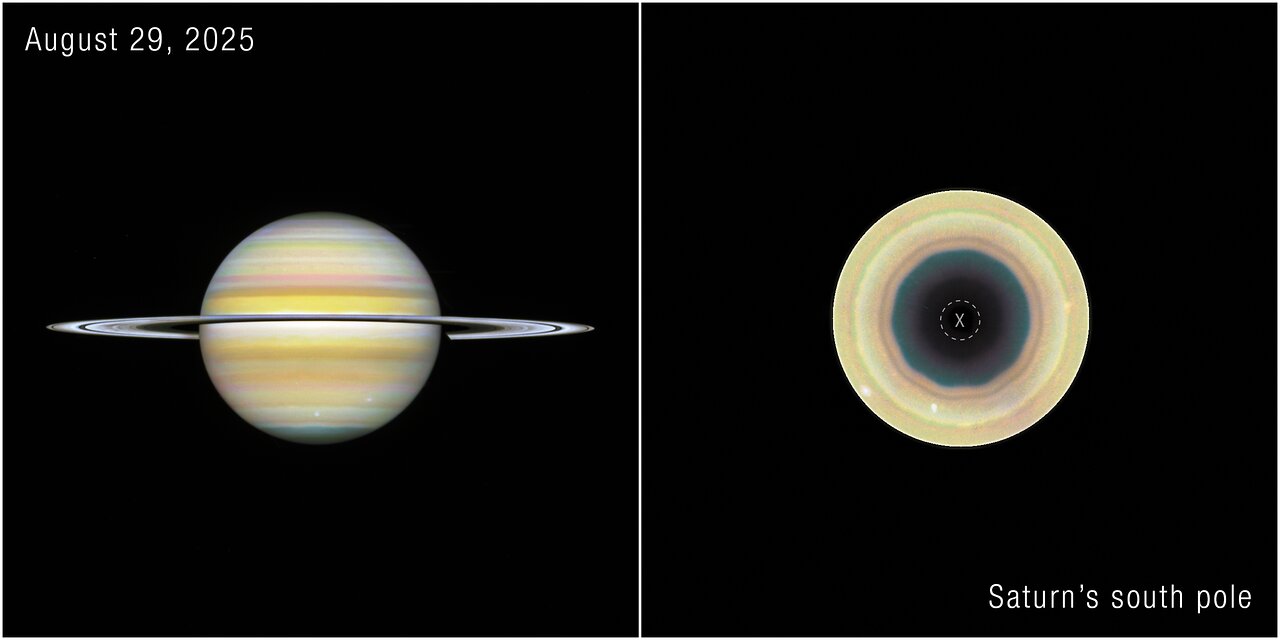
By analyzing Hubble observations from 2023 onwards, researchers identified subtle hints of the structure before it became a defined pattern. These observations were part of Hubble's Outer Planet Atmospheres Legacy (OPAL) program. The findings, published in Science Advances, indicate this feature is strengthening, offering a rare chance to observe a giant atmospheric pattern in development.
The discovery was aided by ground-based observations from 2024 and 2025, where astronomers first noticed a subtle undulating band. Hubble's space-based vantage point provided superior image sharpness and resolution, confirming the feature's presence back to 2023. Unlike the long-standing northern hexagon, this decagon has not been observed in previous Cassini spacecraft data.
The decagon wave is situated within a powerful jet stream and extends vertically through multiple atmospheric layers. Its apparent position shifts slightly due to Hubble capturing images at different wavelengths, which probe varying altitudes. Scientists are intrigued by its recent formation and are investigating the reasons behind its sudden appearance.
Further studies using Hubble, the James Webb Space Telescope, and computer models are planned to understand the decagon's formation, duration, and comparison to the northern hexagon. The OPAL program's long-term data collection is crucial for tracking seasonal changes, storms, and evolving atmospheric features, enabling new discoveries about giant planet dynamics.
AI-samenvatting op basis van de bron.
ESA Hubble