ESA Hubble · Ruimte
Hubble Telescope Confirms Early Merger in Milky Way's History
New data from the Hubble Space Telescope provides definitive evidence of a dwarf galaxy merging with the young Milky Way approximately 11.8 billion years ago, pushing back our understanding of galactic evolution by 1.8 billion years.
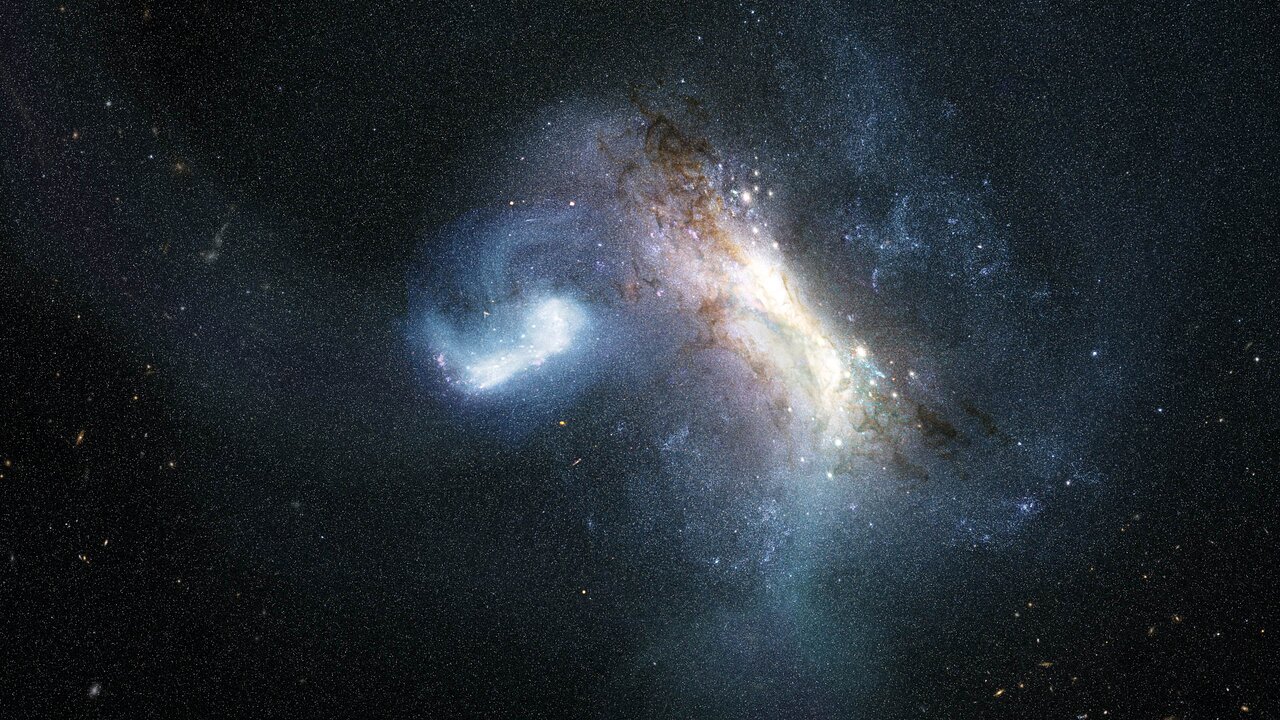
The Milky Way has grown by consuming smaller galaxies, in addition to forming stars from its own gas. While recent mergers like the Sagittarius dwarf galaxy and the ancient Gaia-Sausage-Enceladus merger are known, evidence for an even earlier, significant merger has now been uncovered.
Researchers analyzed Hubble observations of 39 globular clusters, which act as "cosmic archaeological sites" preserving ancient stars. By precisely measuring the age and metal content of these clusters, they identified a third population distinct from those formed within the Milky Way or absorbed during the Gaia-Sausage-Enceladus merger.
These newly identified clusters are older than those from the Gaia-Sausage-Enceladus merger but younger than Milky Way-born clusters. This indicates they originated from a separate dwarf galaxy, named LKH (Low-energy-Kraken-Heracles), which contained about 500 million times the Sun's mass in stars. This merger significantly impacted the early Milky Way's evolution, suggesting that stars from external galaxies played a crucial role from its inception.
The findings challenge previous assumptions that the earliest phases of the Milky Way's evolution were solely defined by internally born stars. Future research will continue to study globular clusters to characterize all major merger events in the galaxy's history.
AI-samenvatting op basis van de bron.
ESA Hubble