designboom · Creativity & design
Robotically 3D Printed Earth Bricks Create Multispecies Habitat
A full-scale earthen pavilion named BUSTAN has been constructed using 178 robotically 3D printed earth bricks. Developed by the Material Topology Research Lab at the Technion and Weizmann Tree Lab, the structure is designed around a living olive tree.
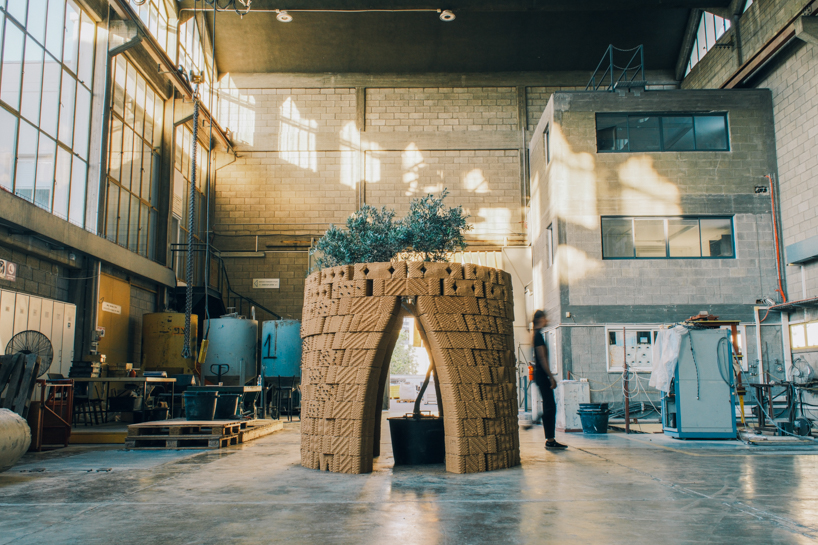
The bricks, made from local soil, plant fibers, and mineral binders, are digitally designed with specific geometries and textures to serve ecological functions like shade, thermal mass, airflow, moisture retention, and habitat creation. The pavilion forms a porous wall that generates a microclimate for the tree's canopy and root zone.
Bespoke brick designs incorporate niches for various species, including insects, birds, small mammals, fungi, and biocrusts. The project proposes architecture as an evolving living system, integrating ancient agricultural practices with computational design and robotic fabrication.
The fabrication process involved collecting local soil, material testing, binder development, and robotic printing at the Technion Advanced Construction Center. This prototype tests how digital tools and local materials can support tree cultivation and multispecies cohabitation.
AI-samenvatting op basis van de bron.
designboom