Hackaday · Creativity & design
Repairing Expensive DDR5 RAM Sticks
A repair shop successfully fixed two high-value registered DDR5 ECC RAM sticks that businesses opted to repair instead of replace.
The first stick, a 128 GB module, failed DDR5 training on boot, indicating potential cracked solder joints on DRAM packages. A reflow cycle was sufficient to resolve the issue, allowing the RAM to pass training.
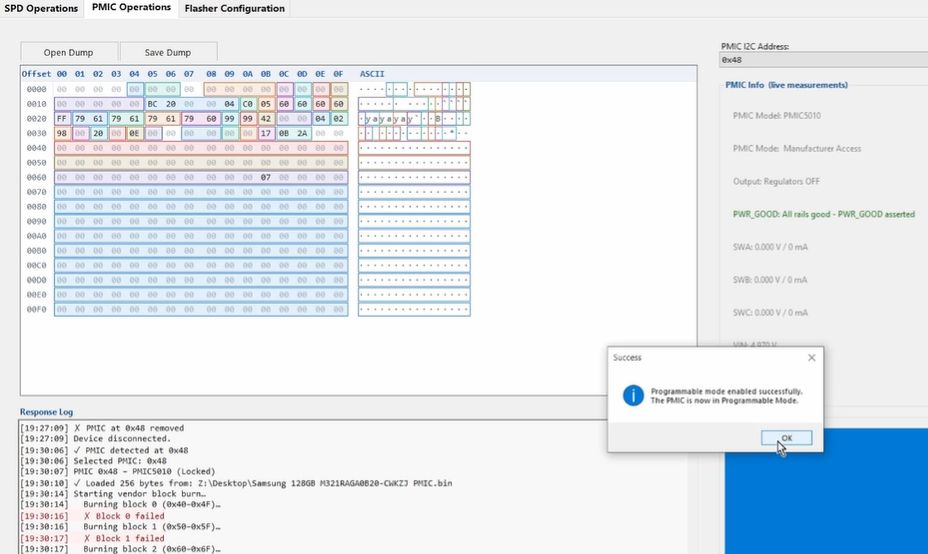
The second stick, a 256 GB module, was completely dead, suggesting a faulty PMIC (Power Management Integrated Circuit) or SPD ROM. The SPD ROM was swapped and reprogrammed, but this did not fix the problem.
Further troubleshooting, including reflowing suspect ICs, yielded no results. The issue was eventually identified as a shorted MLCC (Multi-Layer Ceramic Capacitor) and a damaged PMIC, possibly from the module being dropped.
Cracked MLCCs are a common failure point, often acting as filter capacitors. Checking for shorts across these components can expedite diagnostics.
Given the module was dropped, reballing all ICs was likely a prudent step to address potential cracked solder balls.
AI-samenvatting op basis van de bron.
Hackaday