designboom · Creativity & design
Le Corbusier's Ronchamp Chapel Revisited Through Photography
On what would have been Le Corbusier's 139th birthday, a photographic portfolio by Paul Clemence highlights the unique qualities of his Notre-Dame du Haut chapel in Ronchamp, France. The images focus on the interplay of light, texture, and form.
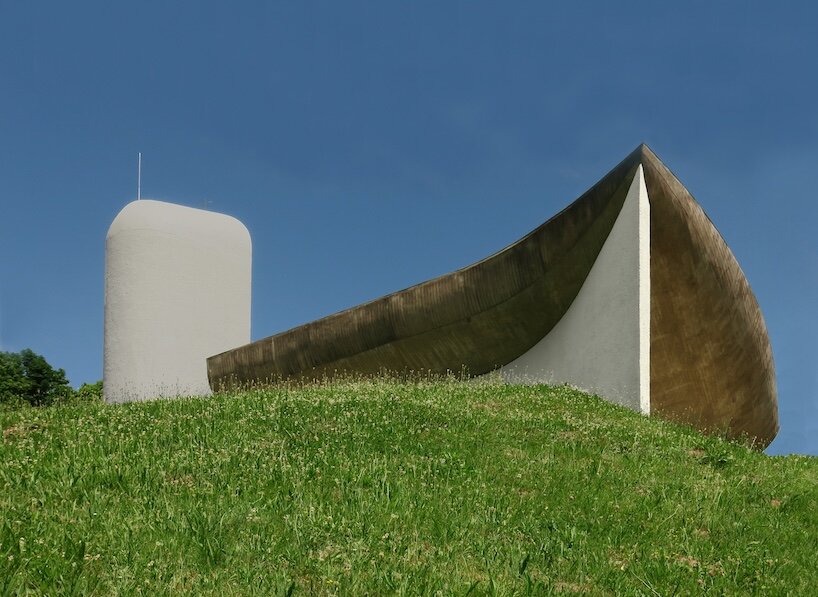
Le Corbusier conceived the chapel, built on the site of a WWII-destroyed predecessor, as a response to its landscape, which he described as having 'four horizons.' Completed in 1955, it marked a departure from his earlier modernist style, featuring curved walls, rounded towers, and a sculptural roof.
Photographer Paul Clemence aimed to capture the chapel with a contemporary sensibility, emphasizing its dialogue with the surrounding environment. The building's form and proportions shift depending on the viewpoint, responding to the landscape.
Inside, light is a key element, entering through numerous openings of varying sizes and depths in the thick south wall. Some openings contain colored glass, casting subtle hues across the interior, creating an atmosphere that changes with the sun.
The chapel was designed for both private reflection and public pilgrimage, incorporating smaller chapels and an outdoor choir area. Stones from the original chapel were reused in its construction.
More than seventy years after its inauguration, Notre-Dame du Haut remains a significant work, recognized as part of Le Corbusier's UNESCO World Heritage inscription. A recent restoration (2022-2025) has renewed its surfaces and interiors.
Clemence's photographs present Ronchamp not as a static icon, but as a dynamic structure whose relationship with its surroundings, light, and mass continues to feel contemporary.
AI-samenvatting op basis van de bron.
designboom