Science News · Wetenschap
Hubble Telescope Discovers Decagonal Jet Stream at Saturn's South Pole
Scientists have identified a peculiar 10-sided jet stream, or decagon, encircling Saturn's south pole, a phenomenon previously unobserved on the planet. This discovery, made using the Hubble Space Telescope and aided by amateur astronomers, suggests that such polygonal atmospheric features may not be as unique as the well-known hexagonal jet stream at Saturn's north pole.
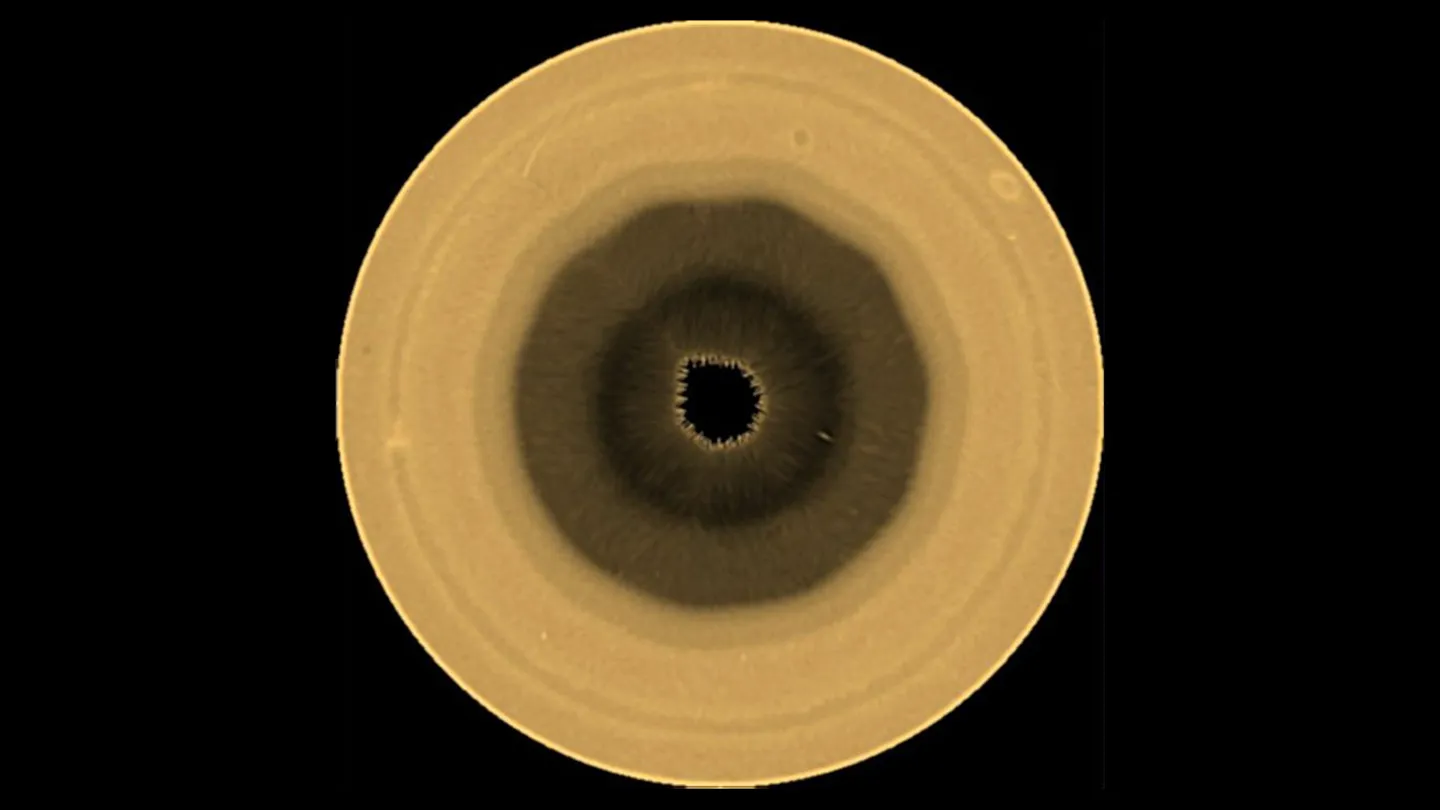
The hexagonal jet stream at Saturn's north pole has been a known feature for decades, first observed by NASA's Voyager probes in the early 1980s. However, the Cassini mission, which studied Saturn for over 13 years, never detected a similar feature in the southern hemisphere, puzzling researchers.
The new findings, reported in Science Advances, indicate that the decagon was visible in Hubble images from late 2023 and even earlier in 2023, though less defined. The exact formation time of the decagon remains unknown, as no spacecraft have observed Saturn since 2017, and the planet's south pole was not visible from Earth between 2012 and 2023.
Planetary scientists note that the decagon appears to be more dynamic than the stable hexagonal jet stream. While gas giants like Saturn are inherently chaotic and windy, with atmospheric features potentially lasting for decades or changing rapidly, the decagon's angular shape is intriguing. This suggests potential insights into the planet's deeper atmosphere.
The exact cause of the decagon is not yet understood, but researchers hypothesize that a nearby storm might have influenced its formation. Future observations, including those from the James Webb Space Telescope and continued Hubble monitoring, are planned to help unravel the mystery behind this newly discovered atmospheric feature.
AI-samenvatting op basis van de bron.
Science News