NASA · Space
Webb Telescope Discovers Smallest Brown Dwarfs
NASA's James Webb Space Telescope has captured a detailed image of the IC 348 star-forming region, revealing unexpectedly small brown dwarfs and young stars.
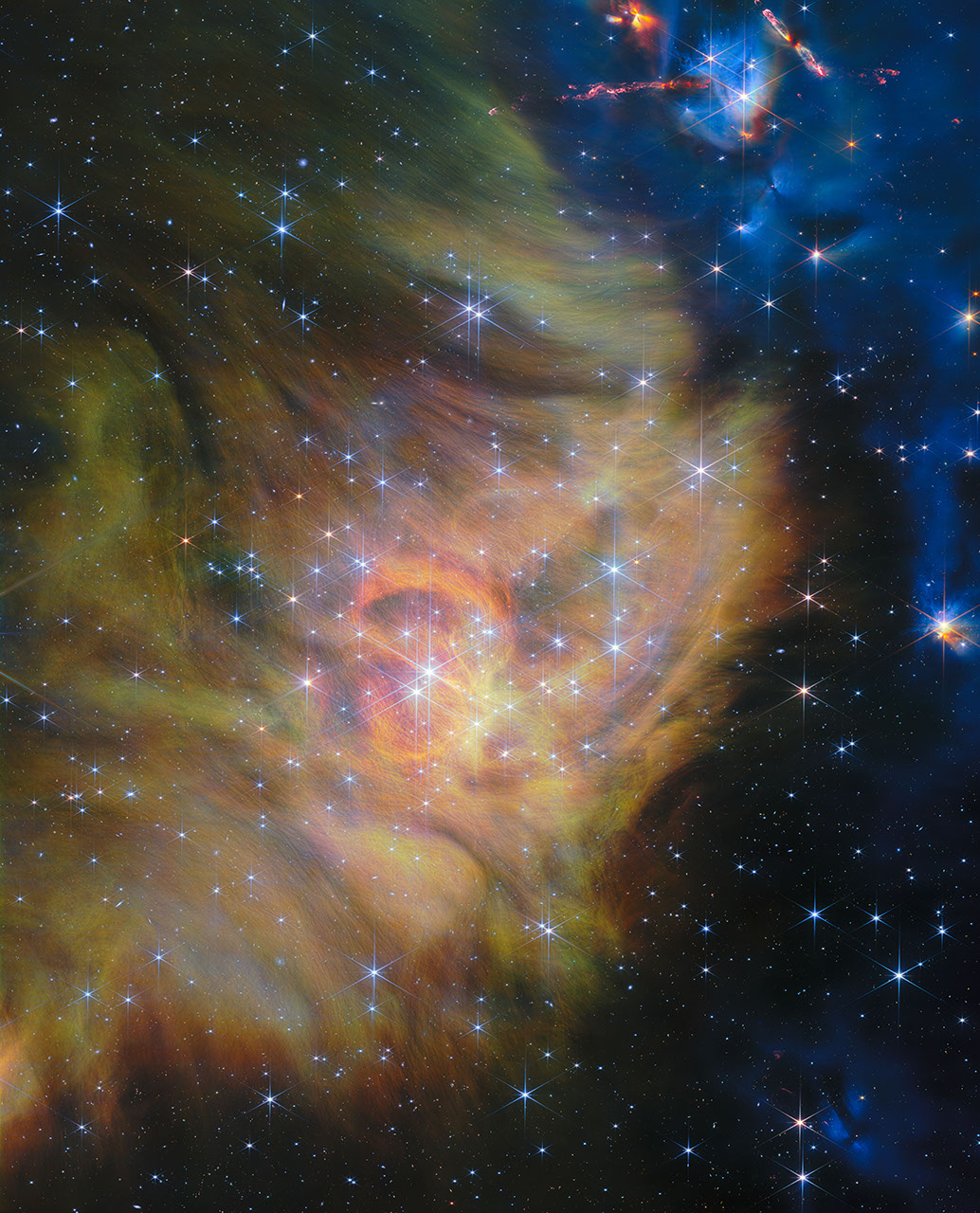
The observations focused on IC 348, located 1,000 light-years away, to investigate the lower mass limit of objects formed during star formation. Researchers used Webb's NIRCam and NIRSpec instruments to identify brown dwarfs with masses as low as twice Jupiter's mass, or 0.19% of the Sun's mass. These findings challenge current models of star formation.
Brown dwarfs form like stars but lack the mass to sustain hydrogen fusion. The newly discovered objects are the least massive brown dwarfs known, pushing the boundaries of our understanding of stellar nurseries.
One of the smallest brown dwarfs observed shows signs of a disk, suggesting that planets might be forming around an object with planet-like mass. Additionally, a unique hydrocarbon signature was detected in the atmospheres of these low-mass brown dwarfs, potentially indicating a new spectral class.
The image also showcases protostars with Herbig-Haro objects, which are luminous regions created by jets from newborn stars impacting surrounding gas and dust. Notable features include HH 797 and HH 211, illustrating active star formation processes.
AI-samenvatting op basis van de bron.
NASA