NASA · Space
Webb Telescope Studies Planet-Shattering Collisions in Young Star Systems
NASA's James Webb Space Telescope is providing new insights into extreme debris disks, young stellar systems experiencing violent collisions, which may mirror early events in our own solar system.
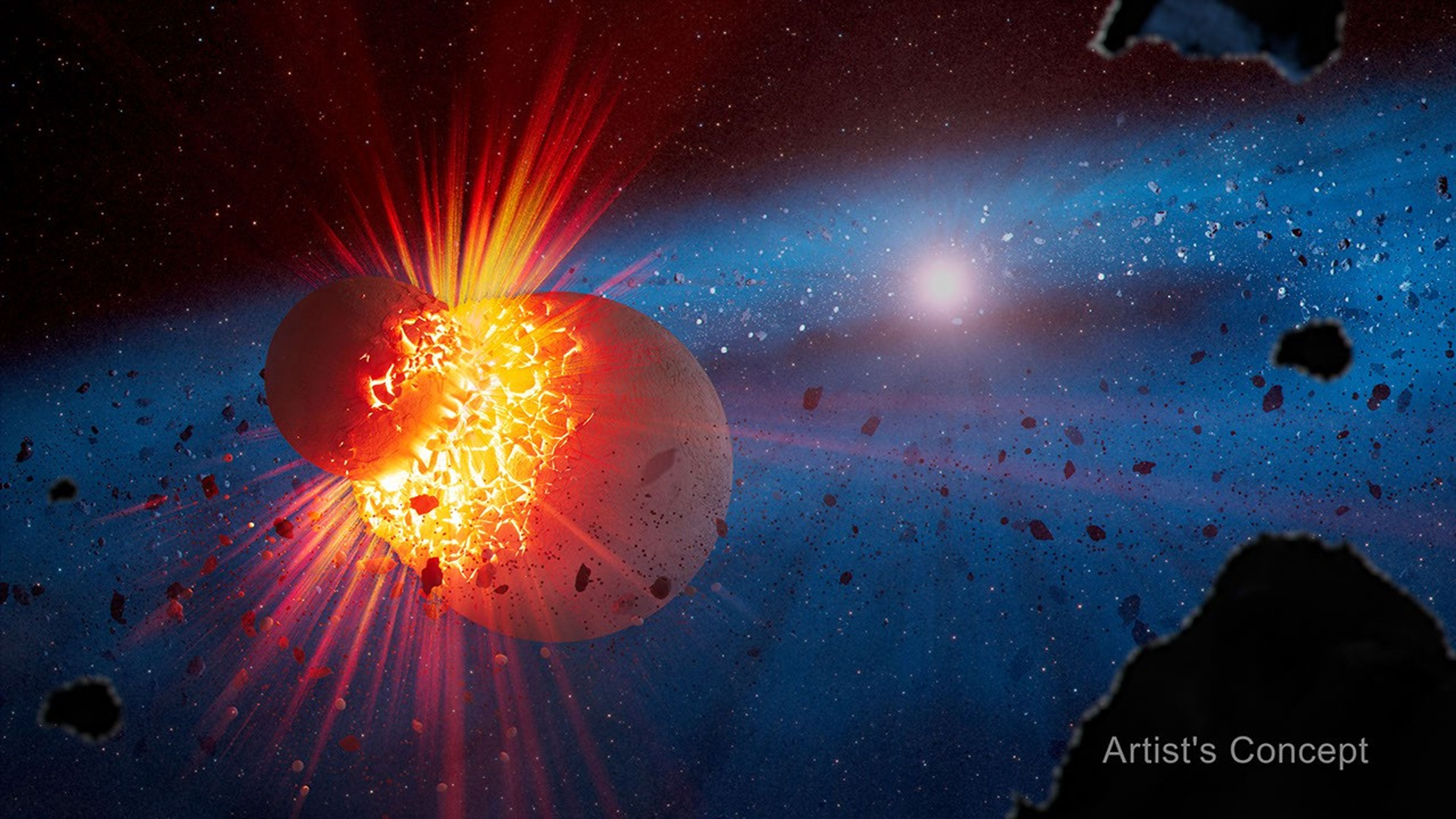
Astronomers used Webb to study these rare systems, which contain large amounts of warm dust near the star, similar to where rocky planets form. Contrary to predictions, these extreme debris disks are observed in only about 1% of young stars.
The Webb observations revealed that these disks have smaller dust grains, a high concentration of warm dust, and irregular brightness variations. The composition of the dust helps categorize the disks.
Silica-rich disks, about one-third of the sample, are thought to result from high-energy impacts between Mars-sized bodies, vaporizing material. These are found around stars younger than 300 million years.
The remaining silica-poor disks are attributed to less energetic collisions between Moon-sized objects. These disks persist across a wider age range and show more variability, possibly due to orbital changes and impacts.
These findings help scientists understand planet formation and evolution, potentially shedding light on our solar system's history, including the formation of the Moon from a collision with a Mars-sized object.
The study suggests that silica-rich disks align with the period when terrestrial planets form. Older silica-poor disks might be consistent with the Late Heavy Bombardment hypothesis, where gas giant migration caused catastrophic collisions.
AI-samenvatting op basis van de bron.
NASA