NASA · Space
Webb Telescope Reveals Stellar Nursery NGC 7129
NASA's James Webb Space Telescope has captured a detailed view of NGC 7129, a stellar nursery approximately 3,300 light-years away, revealing previously hidden protostars and stars within its dusty clouds.
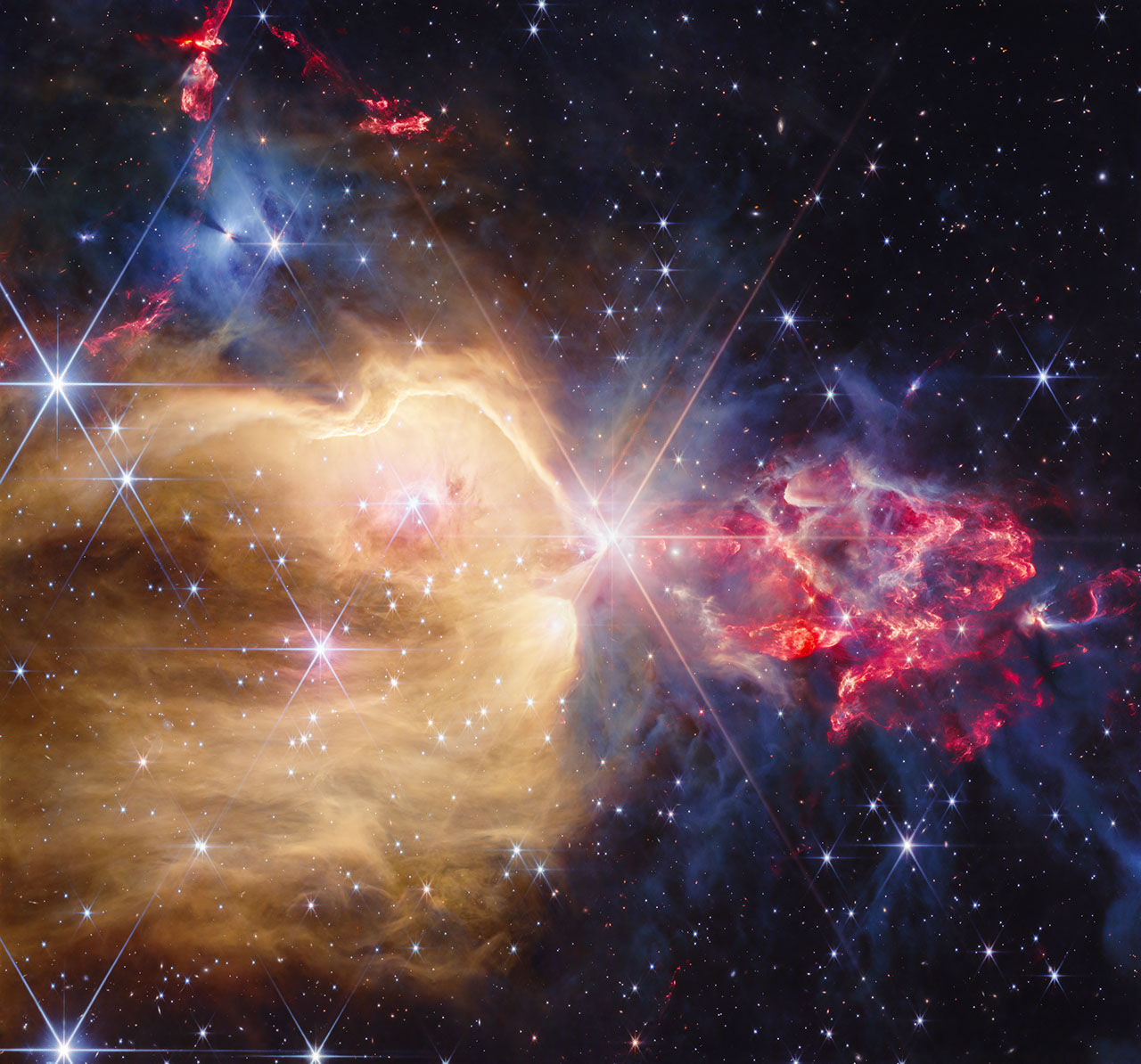
Webb's infrared sensitivity peers through dust, revealing young stars. The image shows hot, atomic hydrogen in gold and cooler, molecular hydrogen in red, shocked by embedded protostars.
The cluster has stars in various stages. The most mature is LkH(alpha) 234, a pre-main-sequence star 5-8 times the Sun's mass. Its outflows carved a 3.5 light-year cavity, compressing material for new star formation.
This star and others create a ridge where light pushes against colder gas, forming a photodissociation region where hydrogen molecules break down.
To the right, younger protostars are hidden in clumpy red matter. They eject superheated material, creating shocks and a textured appearance as outflows interact with dense matter.
Protostellar outflows are visible near a blue nebula, where a protostar with a disk casts a shadow. Webb's resolution reveals rich gas structures, building on Spitzer Space Telescope data.
Astronomers will study Webb's data to understand how these stars influence their environment. Webb is a leading observatory for studying the solar system, distant worlds, and the universe's origins.
AI-samenvatting op basis van de bron.
NASA