Science News · Wetenschap
NASA's Roman Space Telescope Set to Revolutionize Astronomical Discovery
After two decades of design and construction, NASA's Nancy Grace Roman Space Telescope, comparable in size to a tour bus, has launched. It is expected to begin delivering groundbreaking astronomical data early next year, promising to unlock mysteries of dark matter and dark energy, detect thousands of exoplanets, and observe galactic interactions and exploding stars.
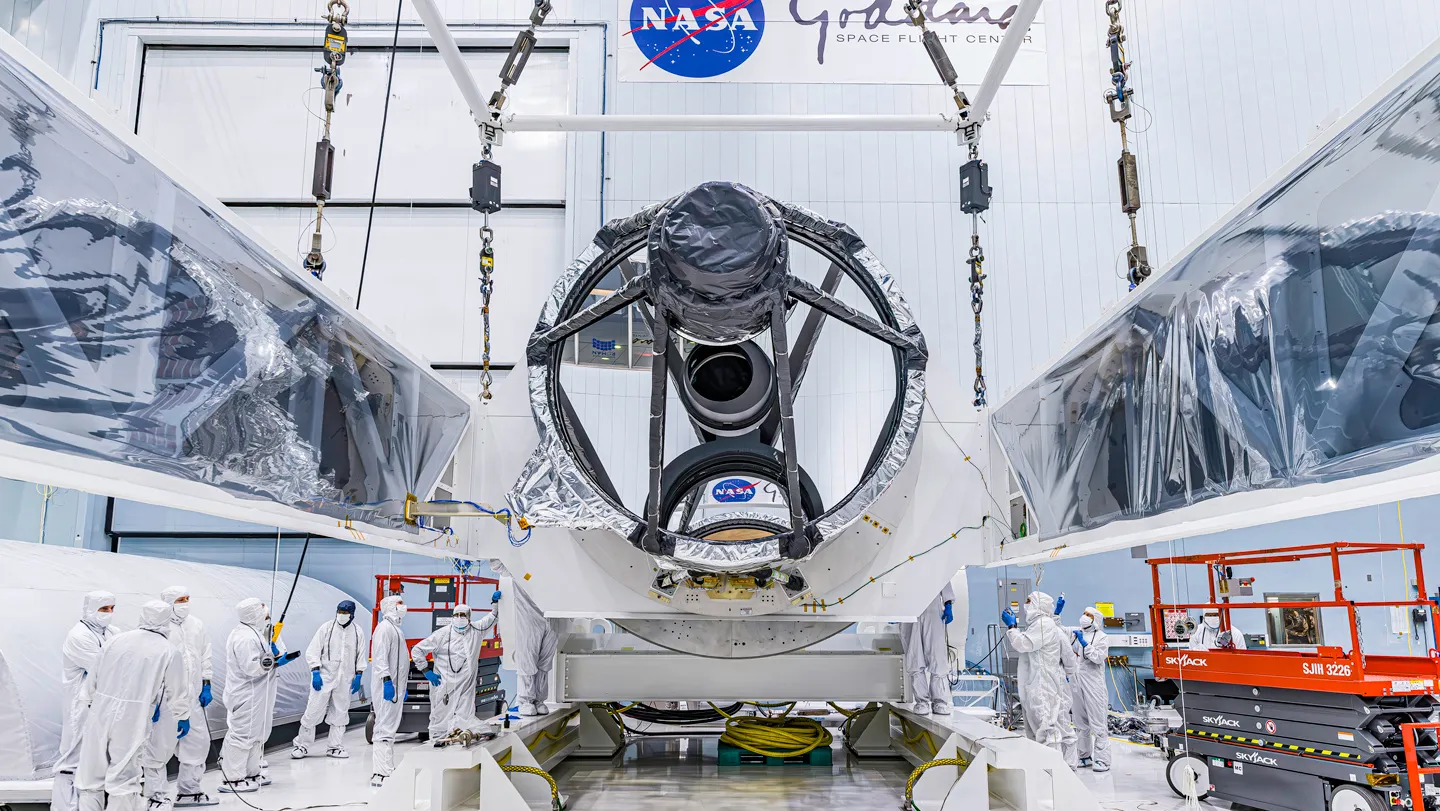
The Roman Space Telescope's strength lies in its extensive surveys, covering vast areas of the sky with a field of view 100 times larger than Hubble's. This broad vision allows it to gather widely applicable data and optimize for discoveries in key areas, impacting nearly all fields of astrophysics.
A primary mission objective is to shed light on the dark universe. Roman will observe signatures of dark matter by detecting subtle changes in galaxy shapes caused by its gravitational lensing effect. It will also detect approximately 21,000 supernovae to measure the accelerating expansion of the universe and map billions of galaxies to understand their distribution over cosmic time, potentially confirming or disproving theories about dark energy.
The telescope will also employ two techniques to discover exoplanets: transits, which detect planets passing in front of their stars, and microlensing, which uses the bending of light by massive objects to find planets farther from their stars. This dual approach is expected to identify tens of thousands of exoplanets, providing insights into the diversity of planetary systems and the formation of our own solar system.
Beyond its primary goals, Roman's powerful optics and planned surveys will enable a wide range of astronomical observations. It will observe stellar phenomena, track asteroids within our solar system, and study the galactic bulge of the Milky Way, an area rich in stars but obscured by dust. Scientists anticipate unexpected discoveries, referred to as 'absolute surprises,' that could shape future research for decades.
AI-samenvatting op basis van de bron.
Science News