NASA · Space
Hubble Telescope Captures Unusual Spiral Galaxy NGC 4698
The NASA/ESA Hubble Space Telescope has imaged NGC 4698, a spiral galaxy located 55 million light-years away in the Virgo Cluster. While appearing serene, this galaxy exhibits peculiar characteristics that set it apart from typical spiral galaxies.
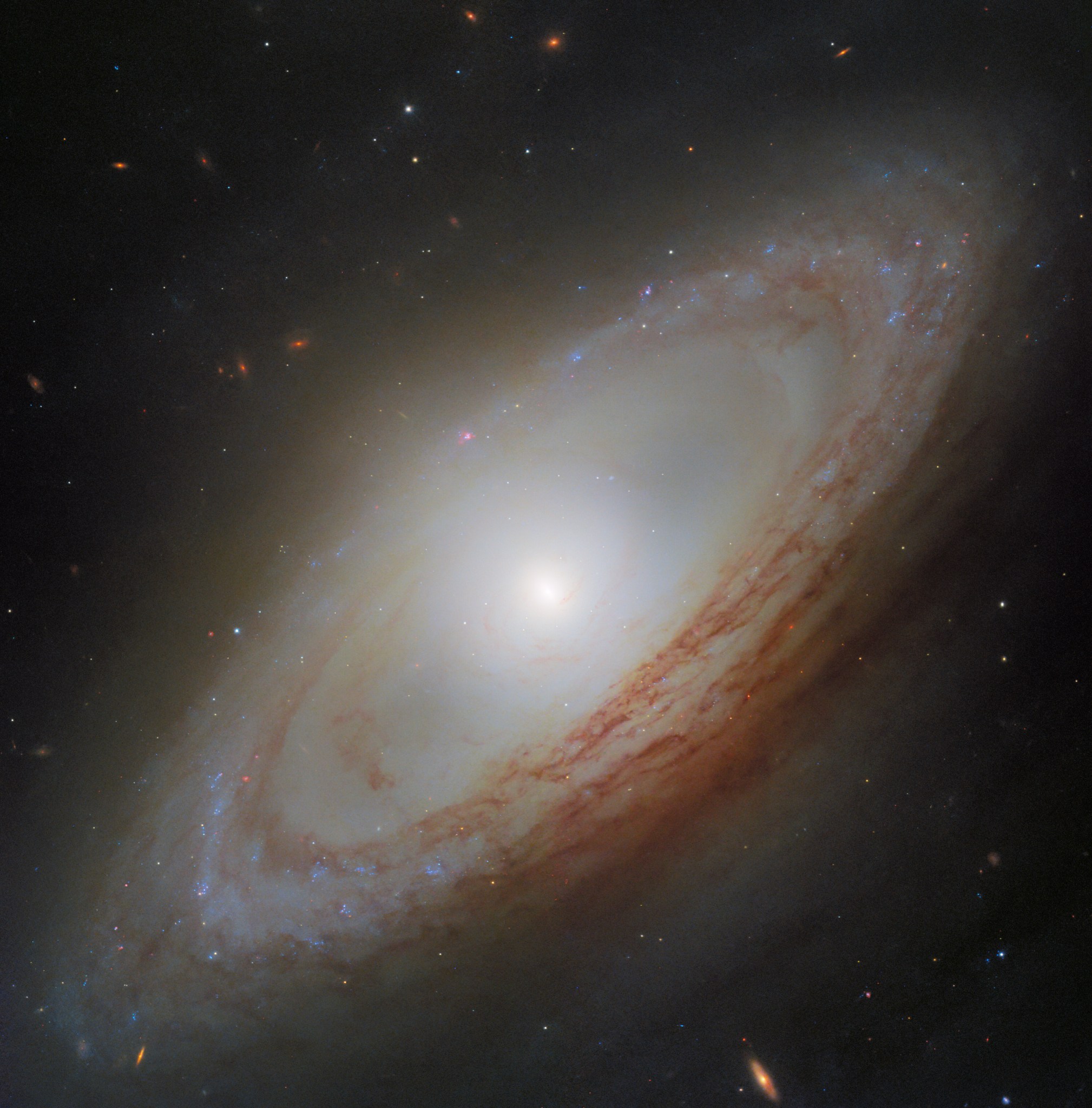
NGC 4698, similar to the Milky Way, features spiral arms with dust and young blue stars. However, its arms are prominent only in the outer regions, forming a ring-like structure rather than extending to the center. The galaxy's core is dominated by an elongated bulge of older, cooler stars orbiting a supermassive black hole that appears to be actively consuming gas.
A key anomaly is that NGC 4698's bulge extends perpendicularly from its disk, and the stars and gas near its center rotate at a right angle to the rest of the disk. This 'out-of-sync' configuration suggests external influence.
Astronomers hypothesize that NGC 4698 may have acquired gas from an external source, leading to the formation of a central disk misaligned with the main galactic disk. Evidence of a past minor galactic merger, indicated by a hydrogen tail, supports this theory.
The data for this image was collected as part of a program studying galaxies within the Virgo Cluster. This research aims to understand how a galaxy's environment within a cluster impacts its evolution and star formation capabilities by examining details like star clusters and nebulae.
AI-samenvatting op basis van de bron.
NASA