NASA · Ruimte
NASA’s Hubble Spies Superbubble Scene
The Hubble Space Telescope has captured an image of the nebula LHA 120-N44, or N44, located in the Large Magellanic Cloud. This nebula is characterized by a central void, known as a superbubble, and a surrounding shell of gas and dust.
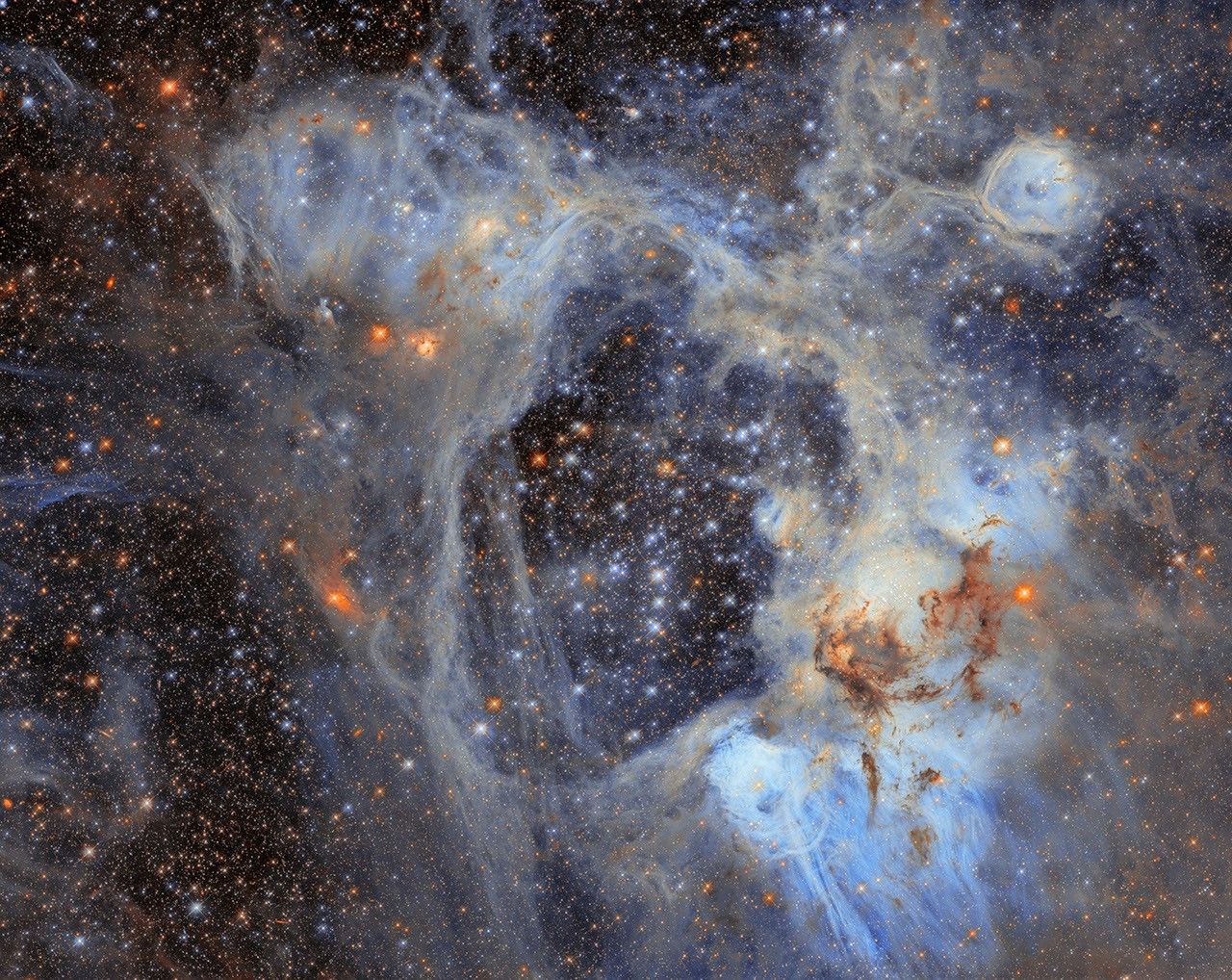
The superbubble in N44, spanning approximately 210 by 140 light-years, was created by the powerful stellar winds and supernovae of stars within its core. These energetic events expelled gas, which then compressed to form a shell around the void. New stars are currently forming within this shell, making N44 a key target for studying star formation processes and the timeline from gas cloud collapse to stellar ignition.
An observing program used Hubble to survey N44, cataloging nearly half a million stars, including about 30,000 pre-main-sequence stars. Hubble's instruments' sensitivity and resolution were crucial in identifying these young stars within crowded clusters. The gas shell glows due to ultraviolet radiation from massive stars and contains distinct features, such as the smaller bubble N44F, which is an interstellar bubble formed by the stellar winds of a single massive star.
Hubble's observations of low-mass stars in this region provide insights into star formation in environments with fewer heavy elements, similar to the Large Magellanic Cloud and early universe galaxies. The N44 nebula itself is a complex structure containing glowing hydrogen gas, dark dust lanes, massive stars, and stars of various ages.
AI-samenvatting op basis van de bron.
NASA