NASA · Space
XRISM Mission Observes Pulsar Accreting Stellar Wind
Astronomers using the NASA-JAXA XRISM observatory have directly observed a pulsar capturing the stellar wind from its giant companion star, powering intense X-ray flares. This provides new insights into cosmic processes.
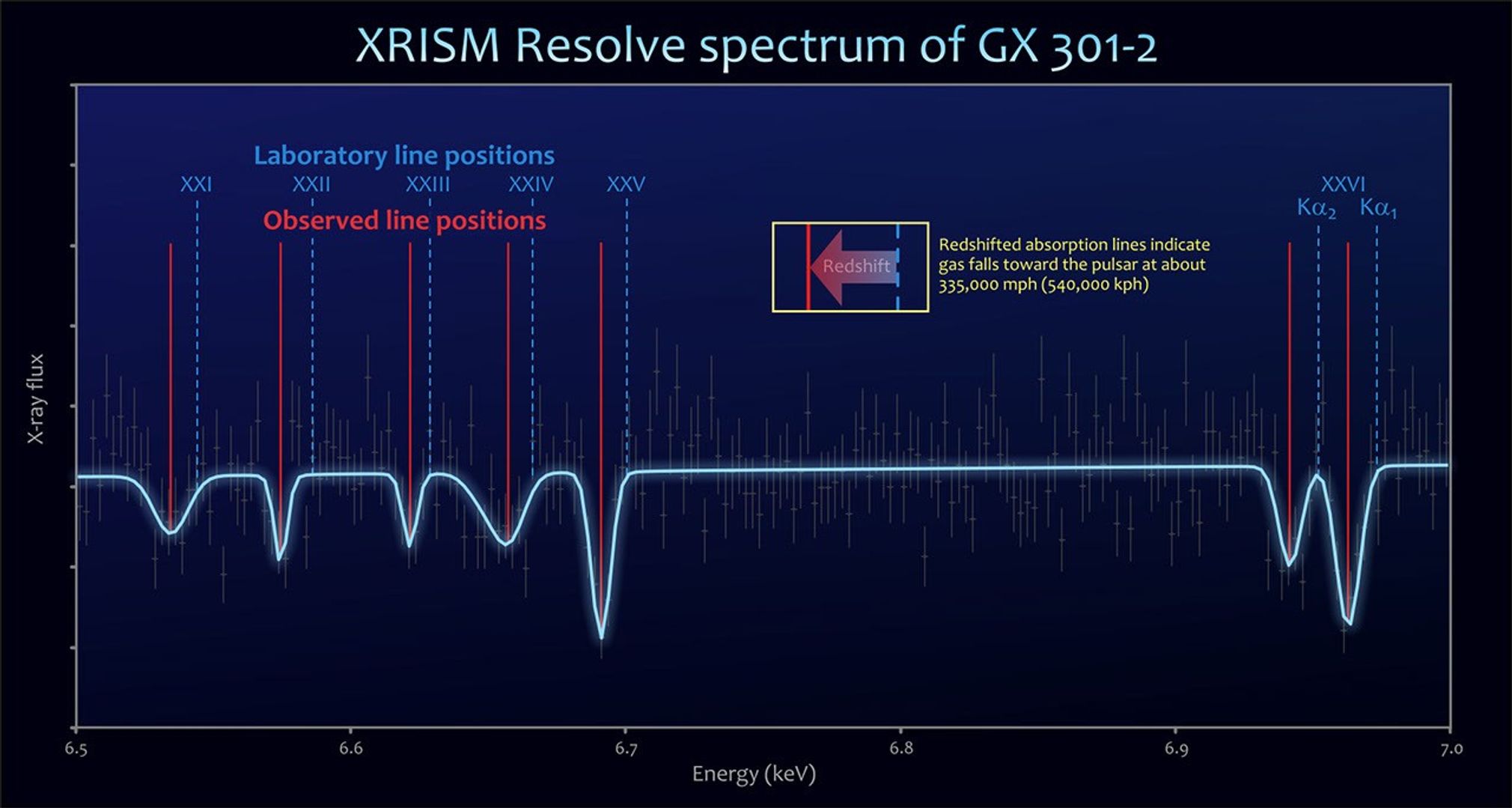
XRISM captured spectra of the BP Crucis system, 13,000 light-years away, featuring a blue hypergiant and a neutron star pulsar.
The hypergiant emits a stellar wind. The pulsar orbits its companion and passes through a dense stream of this wind twice per orbit.
During these passages, the pulsar captures wind matter, forming an accretion disk that emits X-rays, causing flares. Strongest flares occur in the densest wind streams.
XRISM's Resolve instrument detected iron absorption lines revealing plasma speed and direction near the pulsar.
Analysis indicated gas flowed towards the pulsar at approximately 335,000 mph (540,000 kph).
Researchers believe the pulsar sweeps gas into a disk. As it moves deeper, the disk breaks down, and plasma falls directly onto the neutron star.
These observations offer a detailed look at wind-fed pulsar accretion, a process previously not directly observed. The study was published in Science Advances.
AI-samenvatting op basis van de bron.
NASA