NASA · Space
NASA and DOE Partner on Nuclear Space Technology
NASA and the U.S. Department of Energy have signed a memorandum of understanding to accelerate the development of nuclear technologies for space exploration and propulsion, aiming to enhance American leadership in deep-space missions.
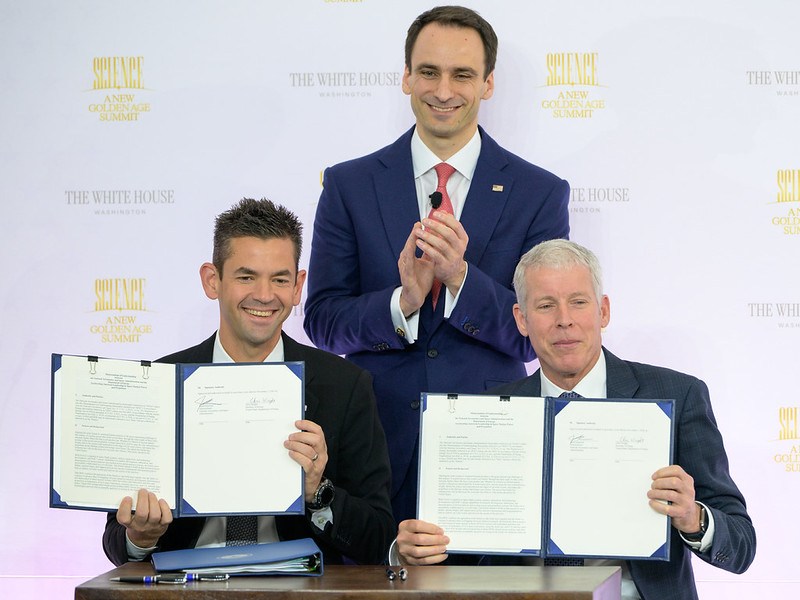
The agreement, "Accelerating American Leadership in Space Nuclear Power and Propulsion," establishes a framework for collaboration across the entire lifecycle of space nuclear development, from research and fuel production to testing and operations, with safety as a central focus.
NASA Administrator Jared Isaacman stated this marks a "Nuclear NASA-era," enabling longer, farther, and more capable missions, with fission-powered spacecraft being a key future development.
This initiative supports President Trump's directive for a launch-ready lunar surface reactor by 2030. It builds on existing collaborations for fission and radioisotope power systems, crucial for a sustained human presence on the Moon and future Mars missions.
The launch of NASA's Space Reactor-1 Freedom in 2028 will transition nuclear propulsion from research to operational deep-space application. This is followed by Lunar Reactor-1, a fission surface power system for a future Moon Base.
These systems will power habitats, communications, instruments, and rovers on the Moon and are essential for Mars missions. They aim to establish a robust domestic nuclear-space industrial base.
NASA is also expanding its use of radioisotope power systems. The Dragonfly mission to Saturn's moon Titan (launching 2028) will use a Multi-Mission Radioisotope Thermoelectric Generator and heater units. Additionally, NASA and DOE will provide heater units for the European Space Agency's Rosalind Franklin Mars rover.
AI-samenvatting op basis van de bron.
NASA