Smithsonian Magazine · People & society
New 'Fire Amoeba' Redefines Heat Limits for Complex Life
A newly identified single-celled organism, Incendiamoeba cascadensis, has been discovered in the hot springs of Lassen Volcanic National Park, challenging previous assumptions about the heat tolerance of complex life.
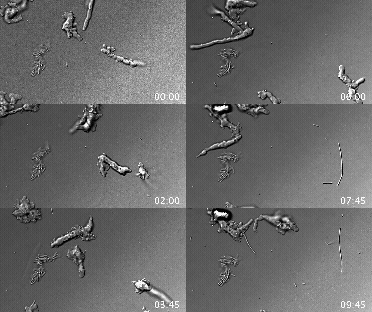
This amoeba can survive and move at temperatures up to 147°F (64°C), surpassing the previous upper limit for eukaryotic organisms.
Eukaryotes are complex cells. While some prokaryotes thrive in extreme heat, research on heat-loving eukaryotes has been limited.
Researchers collected samples from geothermal springs and found the amoebas, culturing them in the lab and testing their heat tolerance.
The amoeba replicated at 145°F and remained mobile up to 147°F, exceeding the prior eukaryotic record of 140°F.
Genetic analysis revealed genes that protect DNA, sense the environment, and maintain protein folding under heat stress.
The discovery has implications for understanding complex cell evolution and expands the search for life on Earth and elsewhere.
Genetic comparisons suggest relatives may exist in other geothermal areas, highlighting the importance of exploring extreme environments.
AI-samenvatting op basis van de bron.
Smithsonian Magazine