Dezeen · Architectuur
MAD's spaceship-like Lucas Museum revealed ahead of opening
The Lucas Museum of Narrative Art in Los Angeles, designed by architecture studios MAD and Stantec, is set to open later this month. The five-storey museum, founded by George Lucas and Mellody Hobson, features a distinctive spaceship-like exterior.
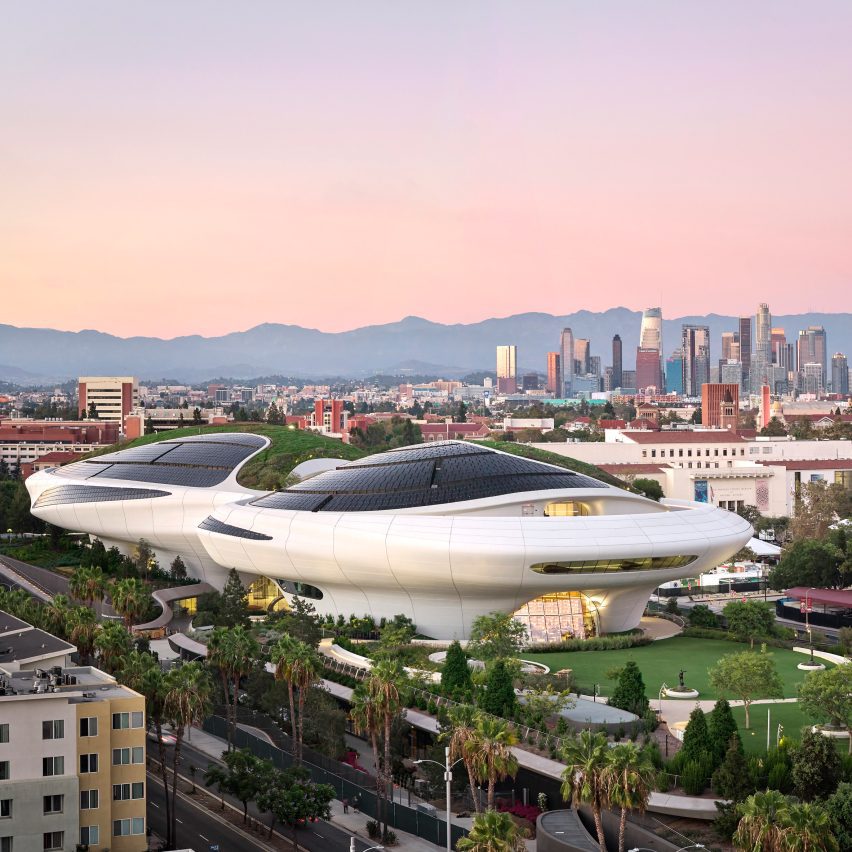
The museum's facade is covered by 1,271 white, fibre-glass-reinforced polymer panels, giving it a smooth, elongated form that narrows in the middle. MAD founder Ma Yansong described the structure as having "emotional architecture space, so that it is fluid in every part." The building's cantilevering edges and arched, glass-filled openings contribute to its otherworldly appearance, designed to seem as if it's floating over the park.
The landscaping by Studio-MLA aims to integrate the museum into its surroundings, with greenery on parts of the roof and a design that mirrors California's natural terrain to create a journey for visitors. Inside, a central semi-enclosed plaza is covered by a structure supporting a large oculus. Visitors access lobbies from the plaza, one featuring wooden cladding and the other white panels with cylindrical glass elevators.
The lower floors house a horseshoe-shaped library, classrooms, a shop, and a cafe. Gallery spaces are primarily on the fourth floor, with views down through the oculus. The fifth floor includes the Skywalker Grill restaurant. While some galleries are traditional, others incorporate the building's curved panelling, particularly in Star Wars-themed sections. The collection spans various art forms, from ancient cave paintings to Star Wars props.
The museum's design also emphasizes seismic durability with 281 base isolators and a surrounding "moat" to accommodate ground movement during earthquakes. The grounds are designed to complement the museum's storytelling theme, with varied topography, paths, and bridges. The museum broke ground in 2018 and will open on September 22.
AI-samenvatting op basis van de bron.
Dezeen