Quanta Magazine · Science
Waddington's Landscape Metaphor Gains New Life
A 20th-century biological metaphor visualizing cell development as a landscape is being revitalized by modern data, offering new insights into organism formation and disease treatment.
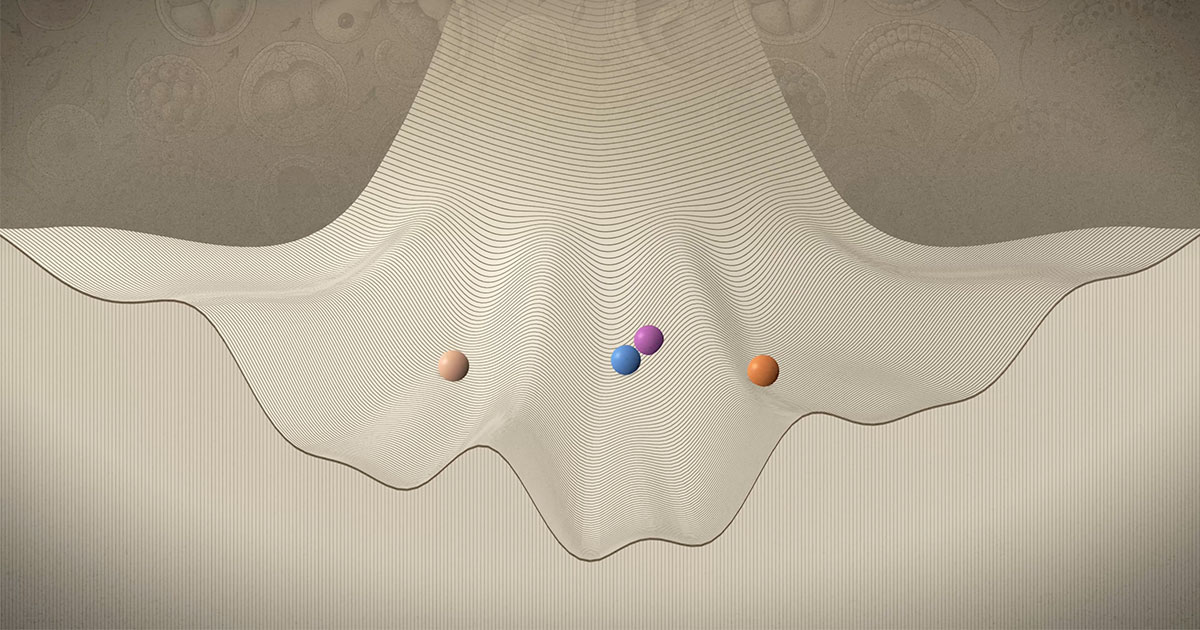
Conrad Hal Waddington's "landscape" metaphor depicted cell development as a ball rolling down hills, explaining how genes shape organismal form during embryonic development.
The metaphor visualized cell differentiation as a ball encountering branching points, leading to specialized cell fates. Cells are "canalized" within valleys, ensuring predictable development.
While a conceptual tool, recent research has mapped actual "landscapes" of cell states using RNA sequencing. This reveals development as a dynamic process where cell communities interact.
This "cartography of development" helps understand how early embryo cells form diverse tissues. It holds promise for regenerative medicine, enabling precise steering of cell populations.
Modern analysis of gene expression data visually resembles Waddington's landscape. Cells cluster into types, and their developmental paths lead to stable "attractor" states.
Researchers view the landscape's height as cell state stability and "pseudo-time" as gene expression progression. The "gravity" driving cells is their collective interaction, reshaping the landscape.
This framework is applied to cancer as an attractor state, suggesting treatments to guide cells to benign states. It also offers possibilities for tissue regeneration.
AI-samenvatting op basis van de bron.
Quanta Magazine