Hackaday · Creativity & design
Bats Use Frequency Matching to Avoid Echolocation Interference
A study investigated how greater Japanese horseshoe bats manage echolocation interference in colonies.
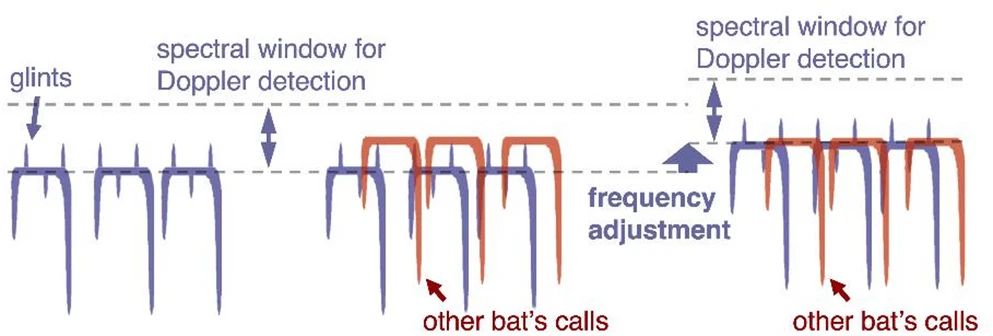
Echolocation, while effective, faces challenges in crowded bat colonies. Researchers studied how greater Japanese horseshoe bats deal with this acoustic interference.
Bats use methods like frequency modulation (FM) and constant frequency (CF) for echolocation. CF is useful for Doppler shift, providing precise location and velocity data.
However, using CF in a busy colony can lead to acoustic interference, hindering echolocation.
The study found that CF component frequencies differ between bat colonies. In experiments with mixed bat groups, bats adjusted their dominant second harmonic (CF2) to match.
Bats with lower CF2 frequencies raised them to match their neighbors, creating a 'silent spectral window' above the CF2 frequency.
This frequency convergence strategy allows bats to avoid acoustic interference and maintain effective Doppler tracking.
While more research is needed, these findings offer insight into bat echolocation strategies.
AI-samenvatting op basis van de bron.
Hackaday