ESA · Space
Mars Rings in New Year
September 30, 2026, marks the beginning of the 38th Martian year, coinciding with the Red Planet's new orbit around the Sun.
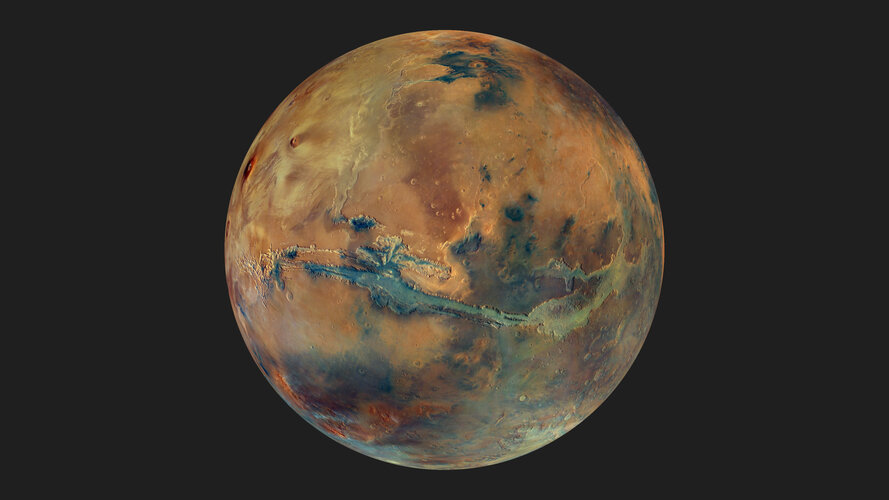
A Martian day, called a 'sol', is slightly longer than an Earth day at 24 hours and 39 minutes. A Martian year is nearly twice as long as an Earth year, equaling 687 Earth days or 668 sols.
The Martian New Year begins on the northern equinox. Like Earth, Mars experiences four seasons, but their lengths vary due to Mars' elliptical orbit and axial tilt, which affects sunlight distribution between hemispheres.
The latter half of the Martian year often sees intense dust storms, sometimes engulfing the entire planet. These storms are triggered as Mars approaches the Sun, causing atmospheric heating and winds to lift fine soil particles.
Temperatures on Mars fluctuate dramatically, with summer daytime highs around 0 ºC dropping to –60 ºC at night. Winter nights can reach –110 ºC. A notable weather event is the Arsia Mons Elongated Cloud, an ice crystal cloud extending up to 1800 km.
AI-samenvatting op basis van de bron.
ESA