Carbon Brief · Klimaat
Tough Methane Cuts Crucial for Limiting Warming Below 2C
A new study suggests that reducing methane emissions is vital for keeping global warming well below 2°C, as current climate strategies often overlook methane's significant short-term warming impact. The research proposes decoupling CO2 and methane reduction targets to better manage global warming limits.
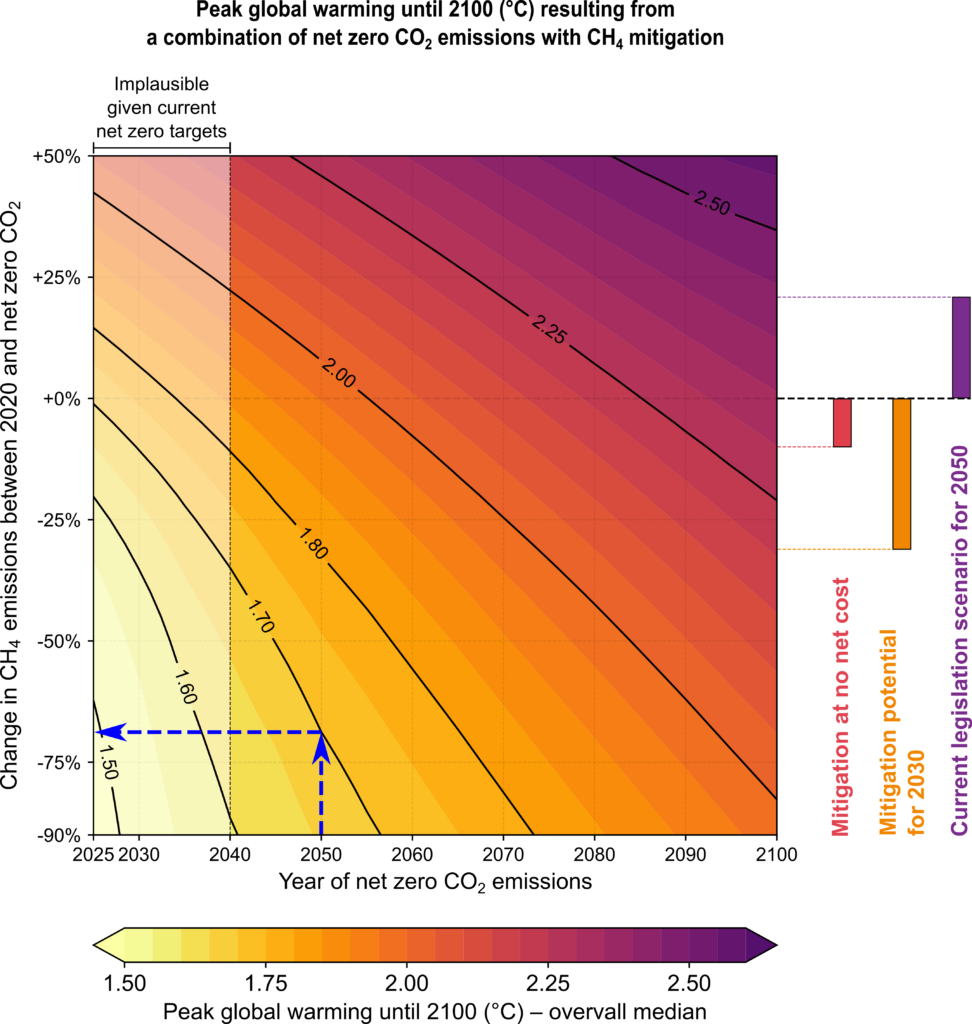
Methane, a potent greenhouse gas second only to CO2, traps heat more effectively but dissipates faster. Reducing methane emissions, primarily from agriculture, fossil fuels, and waste, offers a near-term solution to limit global warming. However, climate strategies frequently focus solely on CO2 or combine all greenhouse gases into a single "CO2 equivalent" metric, obscuring methane's unique impact. This approach makes methane reduction dependent on modeling assumptions and can downplay its importance.
The study, published in Communications Earth & Environment, separates CO2 and methane reduction targets, using global warming limits as the basis for determining necessary methane cuts. It reveals that even with ambitious net-zero CO2 targets, a lack of methane reduction could lead to peak warming exceeding 1.85°C. To stay below the 2°C limit, stringent methane emission cuts must complement net-zero CO2 targets.
The conversion of methane to CO2 equivalent is complex due to differing atmospheric lifetimes and warming properties, making any conversion valid only for specific time horizons and baselines. Metrics like GWP20 (20-year timeframe) emphasize immediate methane mitigation, while GWP100 (100-year timeframe) is commonly used in scientific models and reporting. GWP* considers emission rates, but its interpretation of methane's impact is controversial.
Integrated assessment models (IAMs), used to generate future emissions scenarios, often combine CO2 and methane, making it difficult to isolate the impact of methane cuts alone. These models also tend to assume cost-effective mitigation decisions, which may not reflect real-world climate policy. Only a few countries have specific methane mitigation targets.
The study's approach involves setting a peak global warming limit first and then determining compatible methane reduction targets based on existing net-zero goals. Analyzing scenarios with linear emissions reductions to net-zero, the research found that to limit warming to 1.7°C under a 2050 net-zero CO2 scenario, methane emissions would need to decrease by at least 69% by 2050. If a net-zero target includes all greenhouse gases, a 63% reduction is needed. Current policies, however, project a 20% increase in methane emissions by 2050, which could lead to peak warming above 2°C even with net-zero CO2 emissions.
The research indicates that if methane emissions remain at 2020 levels and net-zero CO2 is achieved by 2040 or later, warming would exceed 1.85°C. Conversely, a one-third reduction in methane emissions, aligning with the Global Methane Pledge target for 2030, could lower peak warming by 0.15°C. The study also highlights that existing carbon budget estimates for limiting warming to 2°C are based on assumptions of significant methane reductions, and without these, the budget shrinks considerably. If methane emissions are not cut, the budget for 1.7°C warming may already be exhausted.
AI-samenvatting op basis van de bron.
Carbon Brief