designboom · Creativity & design
Google Japan's Gboard Kurukuru: A Keyboard on Conveyor Belts
Google Japan has developed an experimental keyboard, the Gboard Kurukuru, which places keys on moving conveyor belts, bringing the characters to the user.
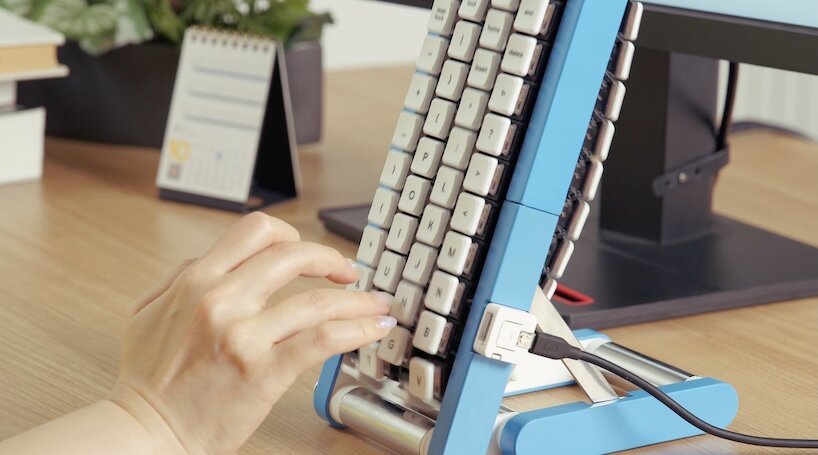
This innovative design features four continuous belts with 29 keys each, totaling 116 keys. Users can keep their hands stationary and press a key as it rotates into position, designed for accessibility with one hand or even a single finger.
The Gboard Kurukuru reverses the traditional keyboard interaction, with the interface moving towards the user instead of the user's fingers reaching for fixed keys. It's envisioned for one-handed use, freeing the other hand, or for two keyboards to be used simultaneously for enhanced productivity.
This is the 15th unconventional Gboard experiment from Google Japan, following previous designs like an elongated row or a double-sided loop keyboard. The project takes everyday interfaces literally and engineers them seriously.
Google is exploring potential variations such as color options and different speed modes, but no commercial products have been announced.
The Gboard Kurukuru is released as open-source, allowing makers to build their own versions using 3D-printed components and mechanical systems. It functions as a kinetic object and desktop machinery, highlighting the movement typically hidden in standard keyboards.
There are no plans for commercial sale. The project serves as a deliberate rethink of the stable keyboard interface, questioning why humans must always adapt to machines. The design was unveiled on October 1, referencing the 101-key layout.
AI-samenvatting op basis van de bron.
designboom