NASA · Space
Pileus Cloud Observed Above Wildfire
NASA scientists captured rare, detailed observations of a pileus cloud forming atop a pyrocumulus cloud generated by the Sand Creek fire in Montana.
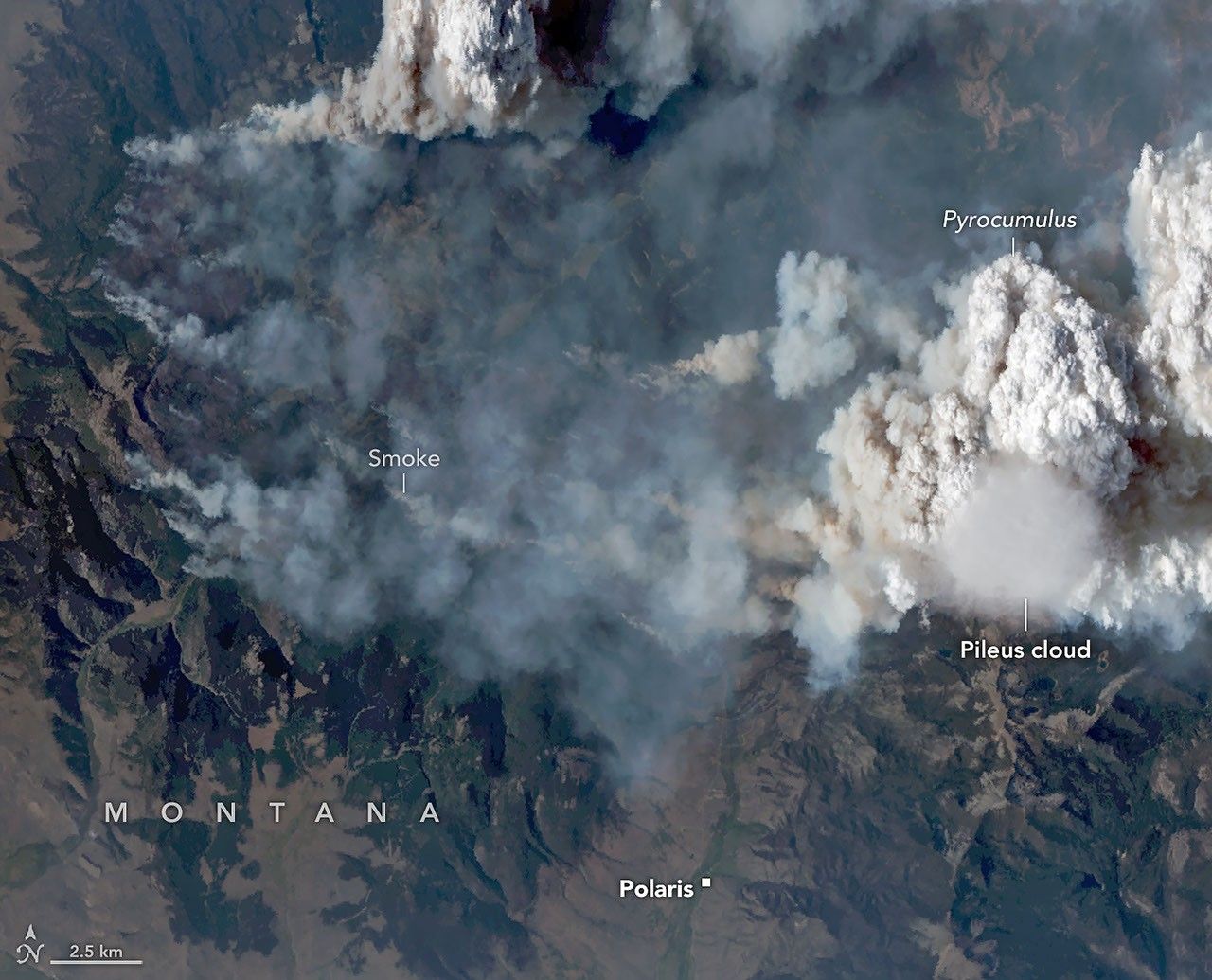
During a NASA INSPYRE campaign flight on August 11, 2026, researchers using the MASTER instrument on NASA’s ER-2 aircraft documented a pileus cloud above a pyrocumulus cloud. Pileus clouds are smooth, veil-like clouds that form when rising air collides with a moist layer aloft, indicating strong convection.
The pyrocumulus cloud, heated by the wildfire, acted as a "mountain" forcing moist air upward. This rising air cooled, causing water vapor to condense and form the pileus cloud. This interaction is rarely observed in such detail.
The MASTER instrument captured images in natural color and false-color using shortwave-infrared observations, which highlighted active fire areas and burned regions. Pileus clouds are typically short-lived, and this one was visible in only one of the collected scenes.
The presence of the pileus cloud suggests extreme updraft dynamics within the fire plume. Scientists were able to map the surface fire behavior, the convective plume, and the cloud processes simultaneously.
Pileus clouds can also form above severe thunderstorms and volcanic eruptions. Previous observations include pileus clouds above thunderstorms in Honduras and a volcanic plume from the Sarychev volcano.
AI-samenvatting op basis van de bron.
NASA