Carbon Brief · Klimaat
Factcheck: 10 flaws in the Conservative report on ‘cheap power’
A new report by the opposition Conservatives argues for a shift away from net-zero targets, advocating for cheaper electricity, even if it means increased gas usage. The party claims this approach would save the UK over £320 billion and encourage electrification, leading to prosperity and a better environment. However, a factcheck by Carbon Brief identifies significant flaws in the report's assumptions and conclusions, suggesting the proposed pathway could lead to higher emissions and slower electrification.
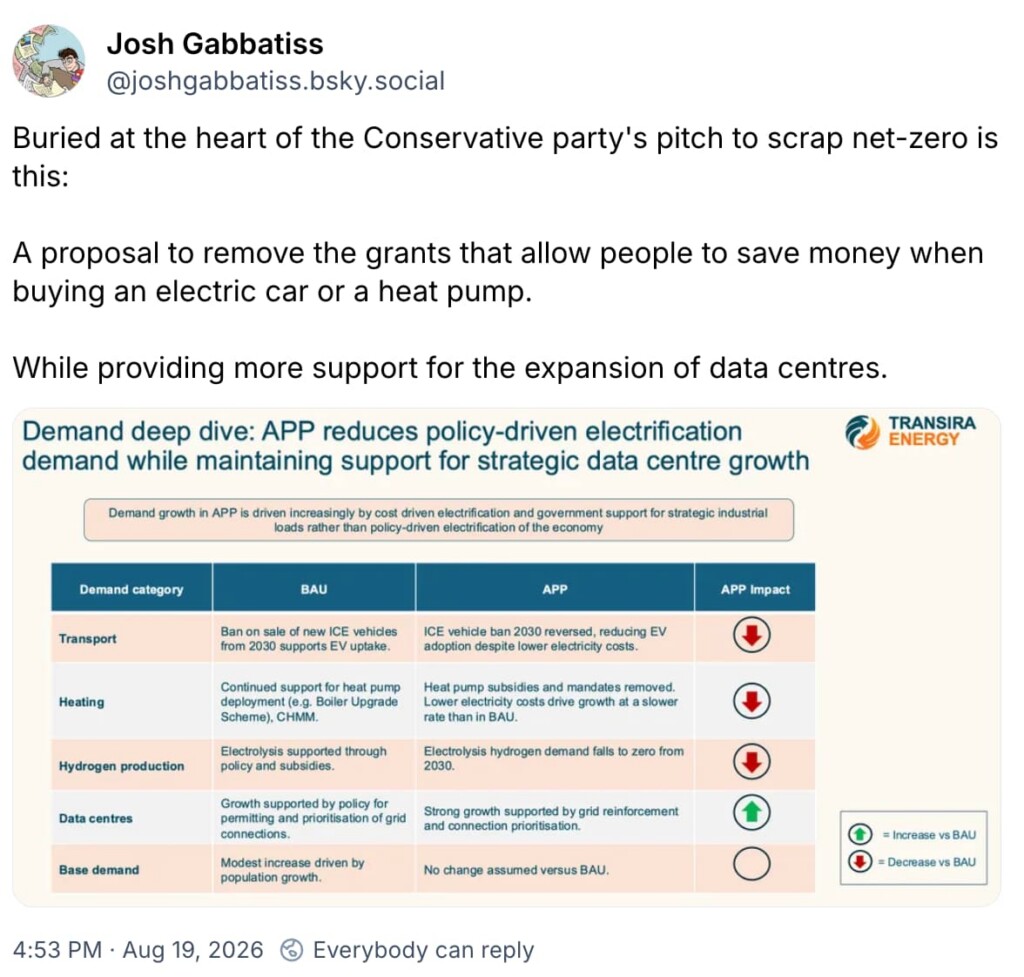
The Conservative plan, outlined in a report by the centre-right thinktank Onward, proposes abandoning the UK's net-zero by 2050 target and associated climate policies, which the party claims are financially burdensome. The core idea is that cheaper electricity would incentivize the adoption of electric vehicles (EVs) and heat pumps, thereby increasing electrification and reducing emissions. This strategy is supported by a report from Onward, which claims potential savings of over £320 billion by scrapping net-zero policies. Shadow energy secretary Claire Coutinho suggests this would make electrification more attractive, benefiting both the economy and the environment. However, the report's alternative scenario projects less electrification of heat and transport and an additional 524 million tonnes of carbon dioxide (MtCO2) emissions by 2050. Experts consulted by Carbon Brief argue that the report's conclusions are based on questionable assumptions, such as the expectation of low and stable gas prices, and that with more credible assumptions, renewables would emerge as the most cost-effective option.
The proposed 'alternative policy pathway' (APP) by Onward, which assumes the abandonment of the net-zero target after 2029, results in an increase of 524MtCO2 emissions between 2030 and 2050, primarily due to a greater reliance on unabated gas-fired power generation. This contradicts the Conservatives' claim that their approach would facilitate emissions reductions. Furthermore, the APP is projected to slow down the electrification of heat and transport. This is attributed to the removal of government subsidies and mandates, such as the boiler upgrade scheme and the ban on new petrol and diesel car sales. While the report suggests lower electricity demand in the APP, experts question this, noting that falling electricity prices and technology costs would likely boost uptake. The report also overlooks significant additional costs, such as the increased expenditure on petrol and diesel for vehicles that would not be electrified, and the costs associated with accelerating grid connections for data centres.
The report's reliance on the assumption of low and stable gas prices is a major point of contention. The APP scenario involves building new gas power plants to meet electricity demand and lower prices, despite gas being a primary driver of recent high energy costs. The report assumes gas prices will return to pre-conflict levels and remain stable for two decades, a projection that experts find difficult to accept given global geopolitical instability. While the report acknowledges increased exposure to gas price shocks in the APP, it downplays the potential impact. The Conservative rhetoric of increasing domestic oil and gas production is also challenged, as the UK is likely to remain dependent on imported gas, subject to global price fluctuations.
The Conservative plan includes building new gas power plants, with Onward assuming a capital expenditure of £650 per kilowatt (kW). This figure is significantly lower than recent analyses, which indicate substantially higher costs for new gas power plants, partly due to a global shortage of gas turbines driven by increased demand from data centres and coal-to-gas transitions.
The report advocates for a significant increase in nuclear power capacity, proposing 20GW by 2050 under the APP, financed through the regulated asset base (RAB) model. However, it presents optimistic cost assumptions for nuclear power that are lower than current project costs. While the report suggests nuclear costs could fall to £122-£138 per megawatt hour (MWh), the strike price for Hinkley Point C is already at the higher end of this range, and Sizewell C has an even higher strike price. The report's cost calculations for new large-scale plants are closer to current estimates but do not adequately explain how costs would decrease substantially, despite acknowledging the need to implement recommendations from the Fingleton review to streamline regulation.
A significant portion of the claimed savings in the Onward report comes from a reduction in network costs, which experts argue is not credible. The APP scenario projects a drastic decrease in network spending by avoiding the connection of geographically dispersed renewable energy assets and relying more on 'firm power' located closer to demand. Critics argue that this projection is based on flawed logic and an underestimate of the grid infrastructure required to support the proposed energy mix, especially with increased demand from EVs, heat pumps, and data centres. The report's claims of savings in both network expansion and balancing costs are also criticized as 'double counting', as network expansion typically reduces balancing costs.
The report's assertion that system integration costs for renewables are excessively high, at £125/MWh, is also disputed. Experts state this figure is far outside mainstream thinking, with other analyses suggesting much lower integration costs for high-renewable systems. The report's calculation is criticized for attributing all additional network and balancing costs solely to new wind and solar deployment, while excluding potential system benefits of renewables, such as reduced wholesale prices and avoided fuel costs.
AI-samenvatting op basis van de bron.
Carbon Brief