Carbon Brief · Klimaat
CMIP7 Emissions Scenarios: A New Framework for Future Climate Projections
Climate modeling groups worldwide are preparing for the seventh phase of the Coupled Model Intercomparison Project (CMIP7), which will utilize a new set of emissions scenarios. These scenarios, replacing the previous "shared socioeconomic pathways" (SSPs), aim to provide a more realistic and refined exploration of future climate change for the IPCC's seventh assessment cycle.
The CMIP7 scenarios differ significantly from their predecessors. Instead of being named by "radiative forcing levels," they are now identified by their emissions trajectories, ranging from "low-to-negative" to "high." They also move away from "no-climate-policy" baselines, focusing instead on the implications of current policies being strengthened, weakened, or maintained. Notably, the highest future emissions have been revised downward, reflecting a less plausible 21st century dominated by coal. Conversely, the lowest emission scenarios have been adjusted upward, acknowledging that some "overshoot" of the Paris Agreement's 1.5C target is now considered unavoidable.
Key highlights from the new scenarios indicate a narrower range of global warming in 2100, projected between 1.6C and 3.3C above pre-industrial levels, compared to the 1.5C to 4.7C range of the SSPs. This marks the first time the upper limit of the scenario range has decreased in four generations of climate modeling. The highest CMIP7 scenario projects 3.3C warming with roughly half the cumulative CO2 emissions of its predecessors. The "medium" scenario, representing current policies, forecasts 2.9C warming by 2100, with a one-in-four chance of exceeding 4C by 2150. Even the lowest scenarios now involve some overshoot of 1.5C, peaking around 1.8C mid-century before returning closer to 1.5C by 2100.
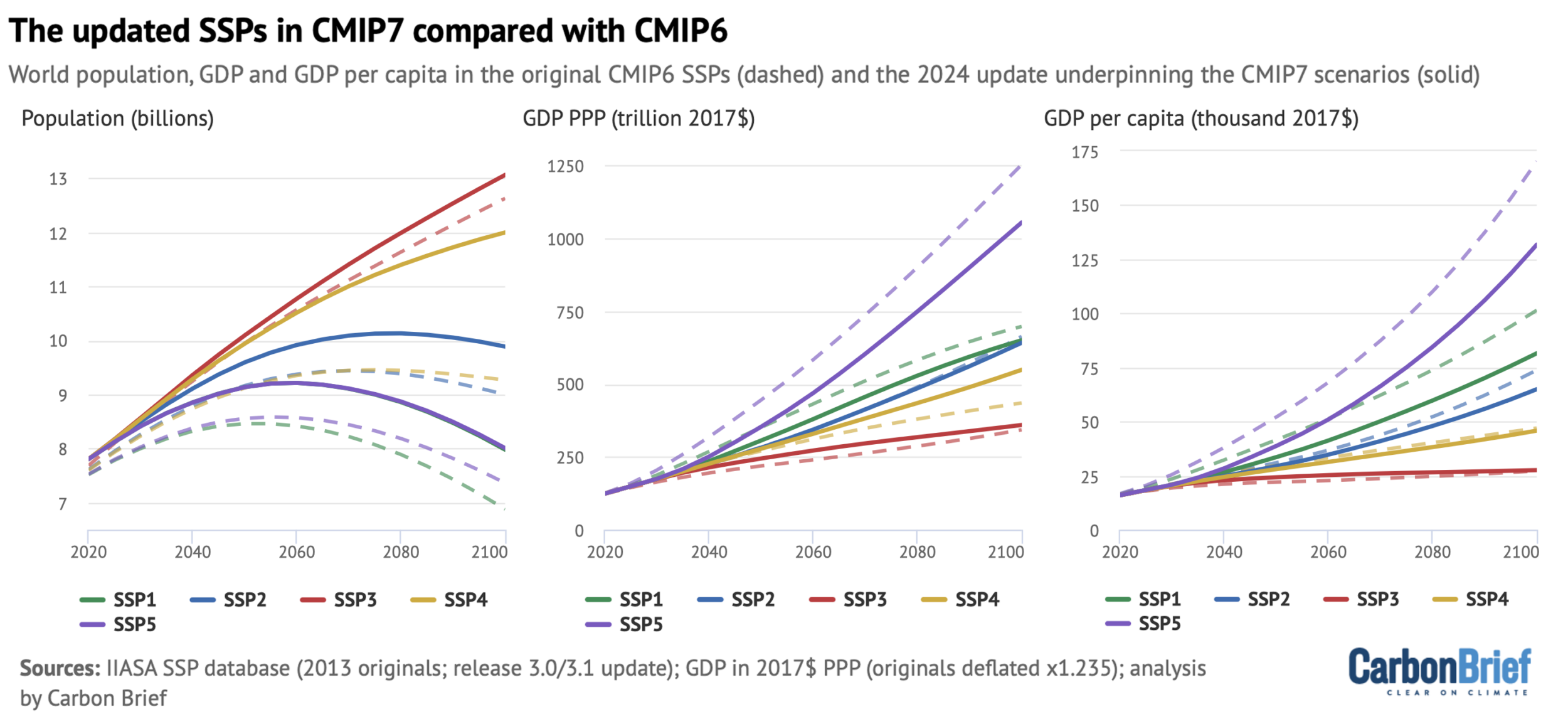
The socioeconomic assumptions underpinning the CMIP7 scenarios depict a more crowded and less wealthy global population than originally envisioned in the SSPs. Updated projections show global population peaking at 10.1 billion around 2080 and per capita income in 2100 being 10-25% lower in most scenarios. The scenarios are primarily based on the "middle-of-the-road" SSP2, with fewer scenarios utilizing SSP1 ("sustainability"), SSP3 ("regional rivalry"), and SSP5 ("fossil-fuelled development"), and none using SSP4 ("inequality").
A significant design change for CMIP7 is the shift from prescribing atmospheric concentrations to driving models with CO2 and other greenhouse gas emissions. This "emissions-driven" approach for CO2 allows for the direct incorporation of uncertainties in carbon-cycle feedbacks into the range of projected warming. Additionally, the new scenarios align emissions with observed trends up to 2023, with divergence only occurring after 2026, ensuring greater realism.
The CMIP7 scenarios also introduce new types of pathways, including "high-to-low," "medium-to-low," and "low-to-negative" scenarios. These are designed to explore futures where mitigation is delayed but followed by a rapid turnaround later in the century. While no specific probabilities are assigned, all scenarios are considered plausible, with the possibility of futures existing outside this defined range.
AI-samenvatting op basis van de bron.
Carbon Brief