Dezeen · Architectuur
Design Overtakes Retail as UK Economy's Biggest Contributor
A new report from the Design Council reveals that the UK's design industry has surpassed the retail sector in economic contribution, generating £136.7 billion in gross value added (GVA) in 2023, a 40% increase since 2019. This growth significantly outpaces the overall UK economy.
The design industry's £136.7 billion GVA in 2023 makes it the largest contributor to the UK economy, exceeding the retail sector's £114 billion and nearly doubling the accommodation and food service industry's £70 billion. The sector's growth of 40% from 2019 is also substantially higher than the UK economy's 24% growth over the same period.
Design Council's chief design officer, Cat Drew, highlighted that 80% of designers work outside traditional design industries, contributing to sectors like healthcare and financial services through digital teams and in-house design roles.
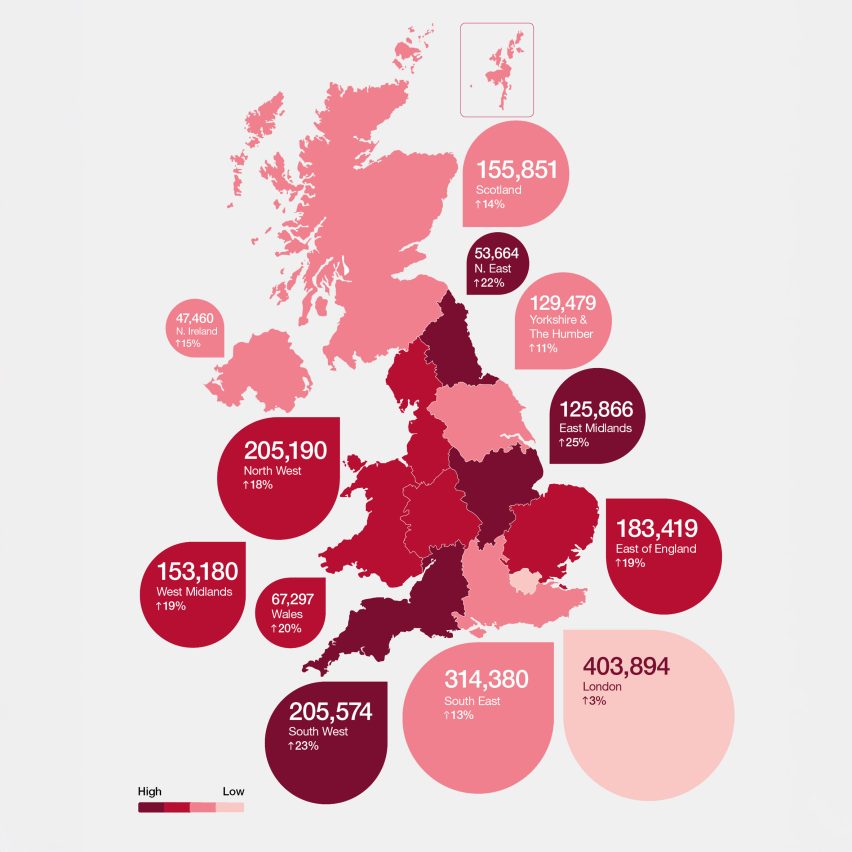
Employment in the design sector has grown by 15% since 2020, adding approximately 297,000 jobs and now supporting 2.27 million jobs, a stark contrast to the UK's overall employment growth of less than 2.5% during the same timeframe.
Design-led growth is expanding beyond London and the southeast, with significant increases in economic contribution reported in Wales (88%), the northeast (67%), and Scotland (32%) since 2019.
While the industry is thriving, artificial intelligence (AI) poses a potential threat to future growth, particularly for roles like graphic design, though demand for UX and UI designers is expected to rise. Digital design has seen a boom, now comprising 59% of the design economy.
Concerns are also raised about the declining number of students pursuing Design and Technology (D&T) at GCSE level and a shortage of D&T teachers. Furthermore, the report points to a lack of diversity in the design workforce, with only 2% of designers being female and 2% being Black in 2025, compared to 5% in the broader UK workforce.
AI-samenvatting op basis van de bron.
Dezeen