NASA · Space
Curiosity Rover Investigates Wind-Formed Ripples and Unusual Geology
NASA's Curiosity rover has been exploring Mount Sharp, recently marking significant milestones including 14 years on Mars and reaching 1 kilometer in elevation gain. The rover's recent activities focused on analyzing wind-formed geological features and unusual rock formations.
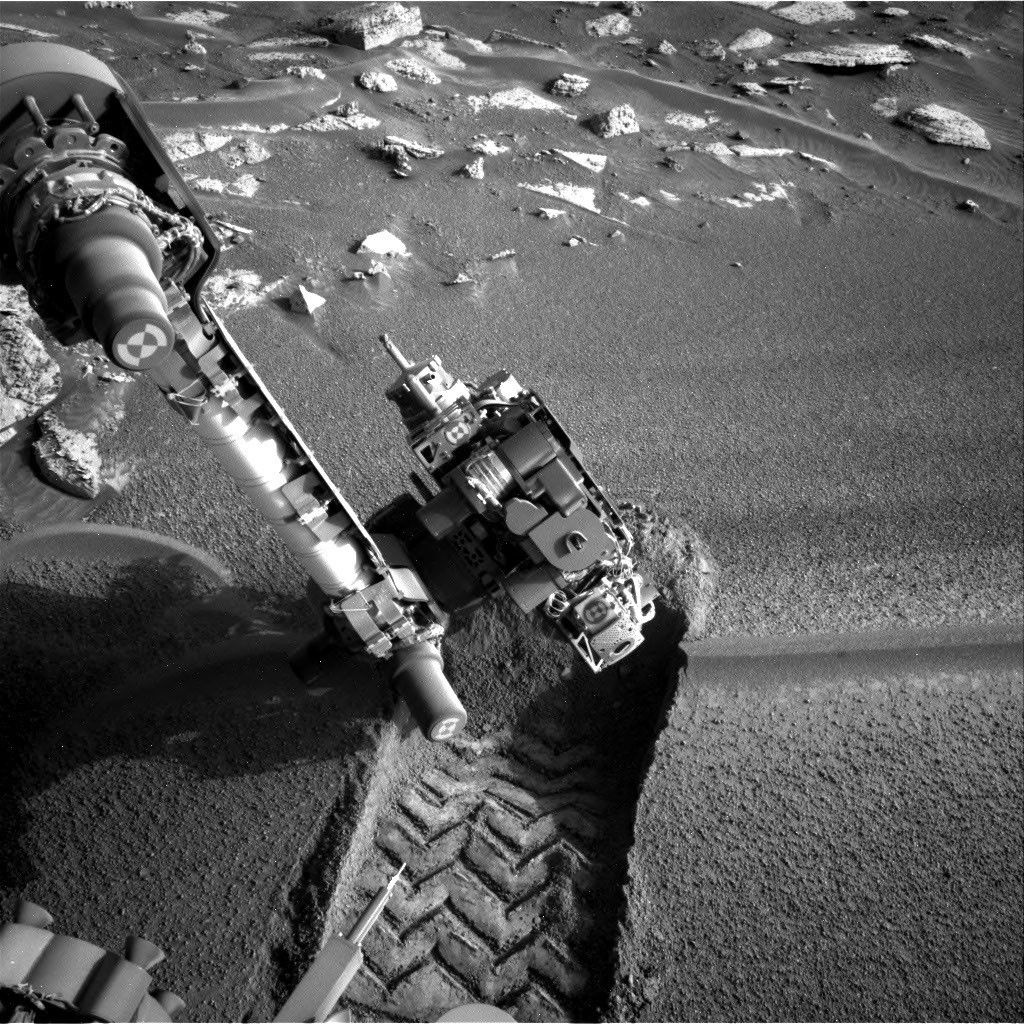
During Sols 5002-5009, the Curiosity team planned complex instrument activities to study a large ripple feature named "Chocolatal." This involved unstowing the rover's arm to perform chemical analyses (APXS) and detailed imaging (MAHLI) of targets within a sand scuff and on the undisturbed ripple.
A particular focus was a MAHLI "Dog's Eye" mosaic, used to image targets edge-on, to examine potential layers visible on the sides of the sand scuff. This technique provides a unique perspective, similar to how a dog close to the ground might view a surface.
The rover also conducted a short drive on Sol 5004. The end-of-week plan included further analyses of an interesting gray stone, which stood out against bedrock containing large nodules not previously observed.
Mastcam observations were directed back toward the Chocolatal area, while ChemCam performed imaging and LIBS (Laser-Induced Breakdown Spectroscopy) observations on other local geological features.
These investigations contribute to the rover's ongoing exploration of Mount Sharp, aiming to understand the planet's geological history and the processes that have shaped its surface, such as wind erosion.
AI-samenvatting op basis van de bron.
NASA