NASA · Ruimte
Curiosity Blog, Sols 4988-4994: More New Tricks for an Old Dog
NASA's Mars rover Curiosity has encountered unusual broad, shallow pits in its workspaces, differing from previously observed pit formations. These features, along with complex layered bedrock and scattered gray float rocks, are providing new puzzles for scientists studying the stratigraphy of Mount Sharp.
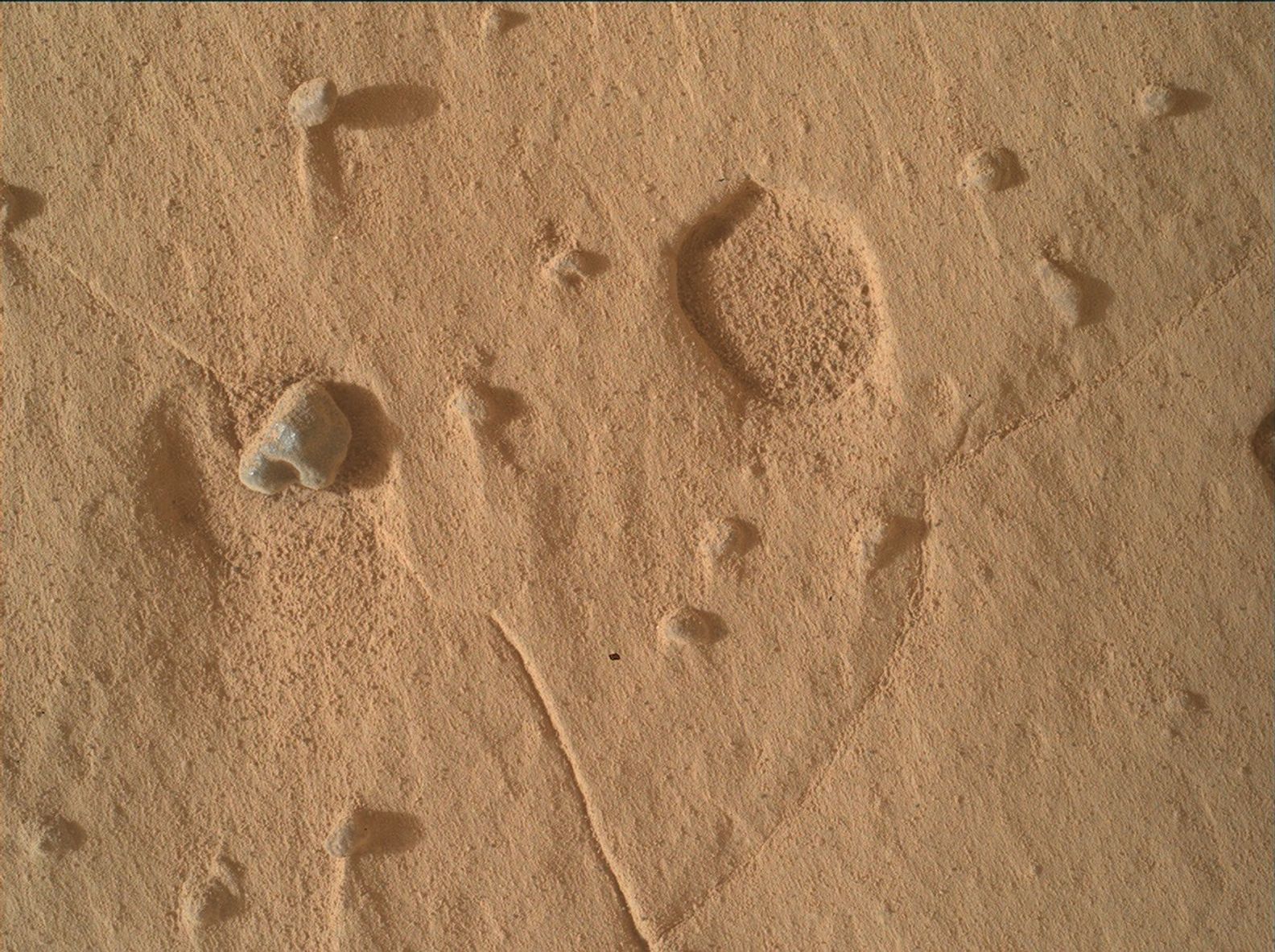
The rover's Mars Hand Lens Imager (MAHLI) captured images of these pits, which are about 1 centimeter in diameter. Unlike typical pits formed by weathering out of nodules, these were broader, shallower, and lacked obvious accompanying objects. MAHLI and Mastcam acquired detailed stereo mosaics and overlapping image sets to create digital elevation models of these structures.
Curiosity also imaged and analyzed "typical" bedrock, revealing complex layers with texture and structure changes over short vertical distances, potentially indicating shifts in depositional conditions. Gray, rough, resistant layers, differing in chemistry from the host bedrock, were also analyzed by ChemCam, MAHLI, and APXS. ChemCam investigated gray float rocks scattered in the workspaces to understand their origins.
Further afield, the "Cordillera" butte was extensively imaged with a comprehensive Mastcam mosaic and focused ChemCam RMI mosaics. The "Tolhuaca" and "Potosí" buttes were also targets for ChemCam, which sought potential crossbedding and assessed the mineralogy of dark capping material on Potosí.
The environmental science team monitored a potential regional dust storm using REMS, Mastcam, and Navcam, observing its dissipation by the week's end. These activities were completed despite a lost planning day due to a downlink issue.
AI-samenvatting op basis van de bron.
NASA