Quanta Magazine · Science
Webb Telescope's 'Little Red Dots': Black Holes or Black Hole Stars?
The James Webb Space Telescope has detected mysterious 'little red dots' from the early universe, sparking a debate about their nature. Initially thought to be distant galaxies, they were later proposed to be supermassive black holes.
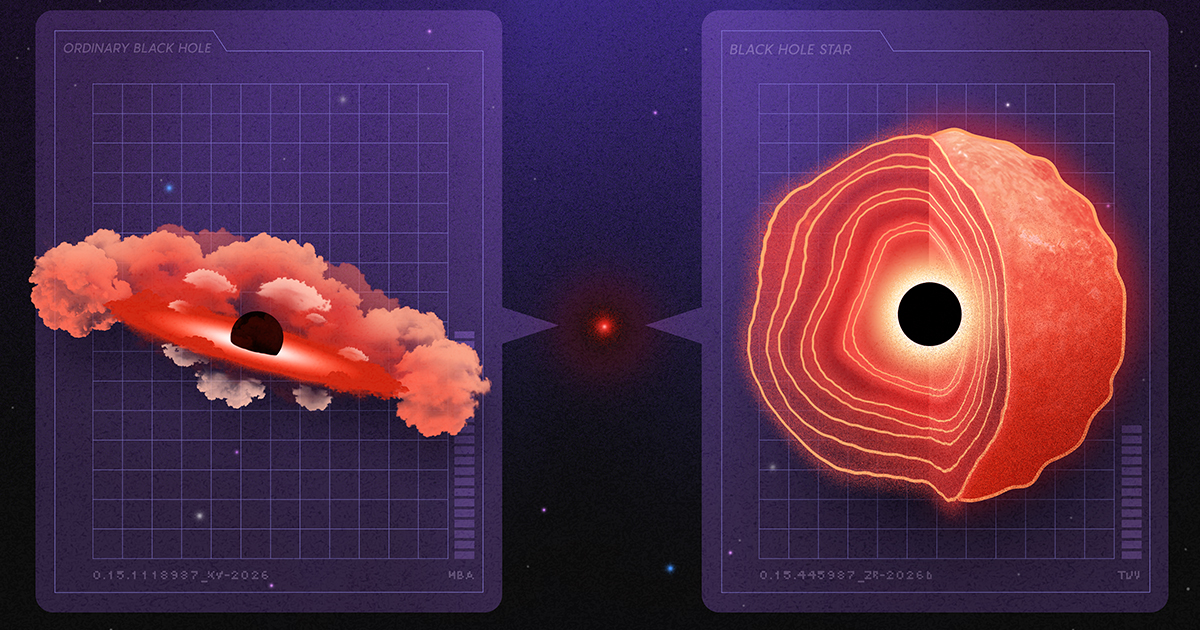
New observations suggest these dots might be 'black hole stars'—massive hydrogen clouds hiding a black hole. This theory posits Webb is witnessing the birth of supermassive black holes within colossal stars.
The 'little red dots' are bright and red, with spectra indicating unique hydrogen interaction. Some interpret this as evidence of black holes consuming gas, others as a stellar-like hydrogen shell around a black hole.
Two teams proposed the 'black hole star' model, combining a black hole's power with a star's appearance. This could explain their brightness, redness, and lack of flickering or X-ray emissions.
However, some astronomers argue the features match standard supermassive black holes, with gas obscuring the view. They suggest 'little blue dots' might be the same black holes viewed differently.
The 'quasi-star' theory, where a black hole forms within a gas cloud, is a potential explanation for black hole stars.
Evidence suggests 'little red dots' become rarer over time, supporting a phase in black hole development. Researchers investigate if they are incubating the universe's first massive black holes.
AI-samenvatting op basis van de bron.
Quanta Magazine