NASA · Space
Webb Telescope Reveals Details of the "Black Eye Galaxy"
The James Webb Space Telescope (JWST) has provided new insights into Messier 64 (M64), a spiral galaxy also known as the "Black Eye Galaxy" due to a prominent dust band. Composite images from Hubble and Webb highlight how the JWST's Mid-InfraRed Instrument (MIRI) can detect dust that obscures visible light.
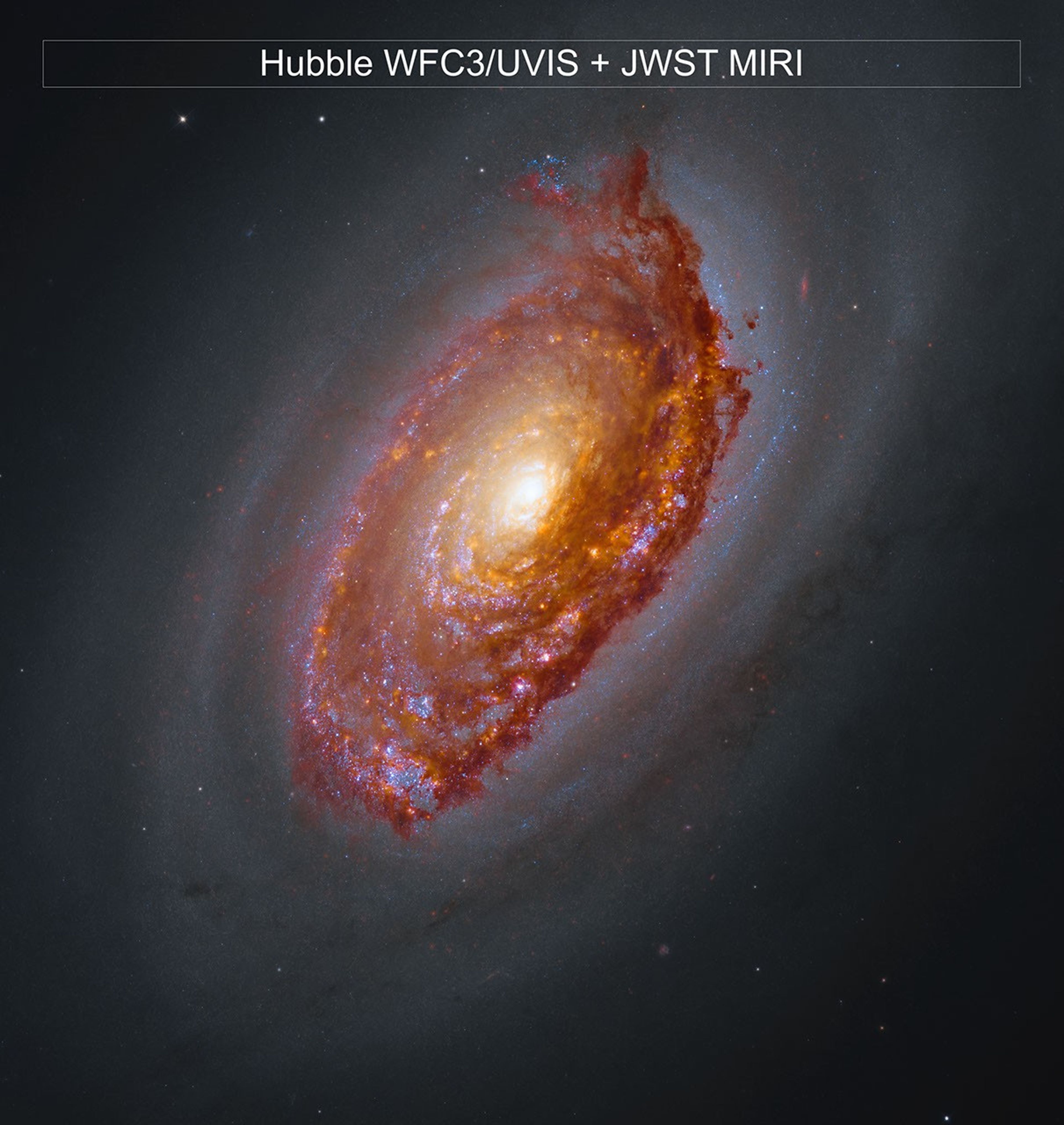
Webb's MIRI instrument, observing in mid-infrared, shows the dust in red as it absorbs and re-emits light from newly formed stars. These young stars appear in pink star-forming regions in the Hubble-only view.
M64's internal gas structures rotate in opposite directions, leading to increased star formation where these gas currents collide and compress. This counter-rotation is likely a result of a past merger with a smaller galaxy.
The study of M64 challenges the previous notion that spiral galaxies have uneventful histories, providing evidence that galaxies, including our own Milky Way, can undergo mergers.
The JWST's observations of M64 are expected to enhance astronomers' understanding of the galaxy's dust composition, structure, and motion, offering further context on its merger history and evolutionary path.
AI-samenvatting op basis van de bron.
NASA