Carbon Brief · Klimaat
US's Two Largest Reservoirs Hit Record-Low Water Levels
Lake Mead and Lake Powell, the two largest reservoirs in the United States and crucial water sources for the southwestern US, have reached record-low water levels. These reservoirs supply water to approximately 40 million people and irrigate millions of acres of farmland across seven states.
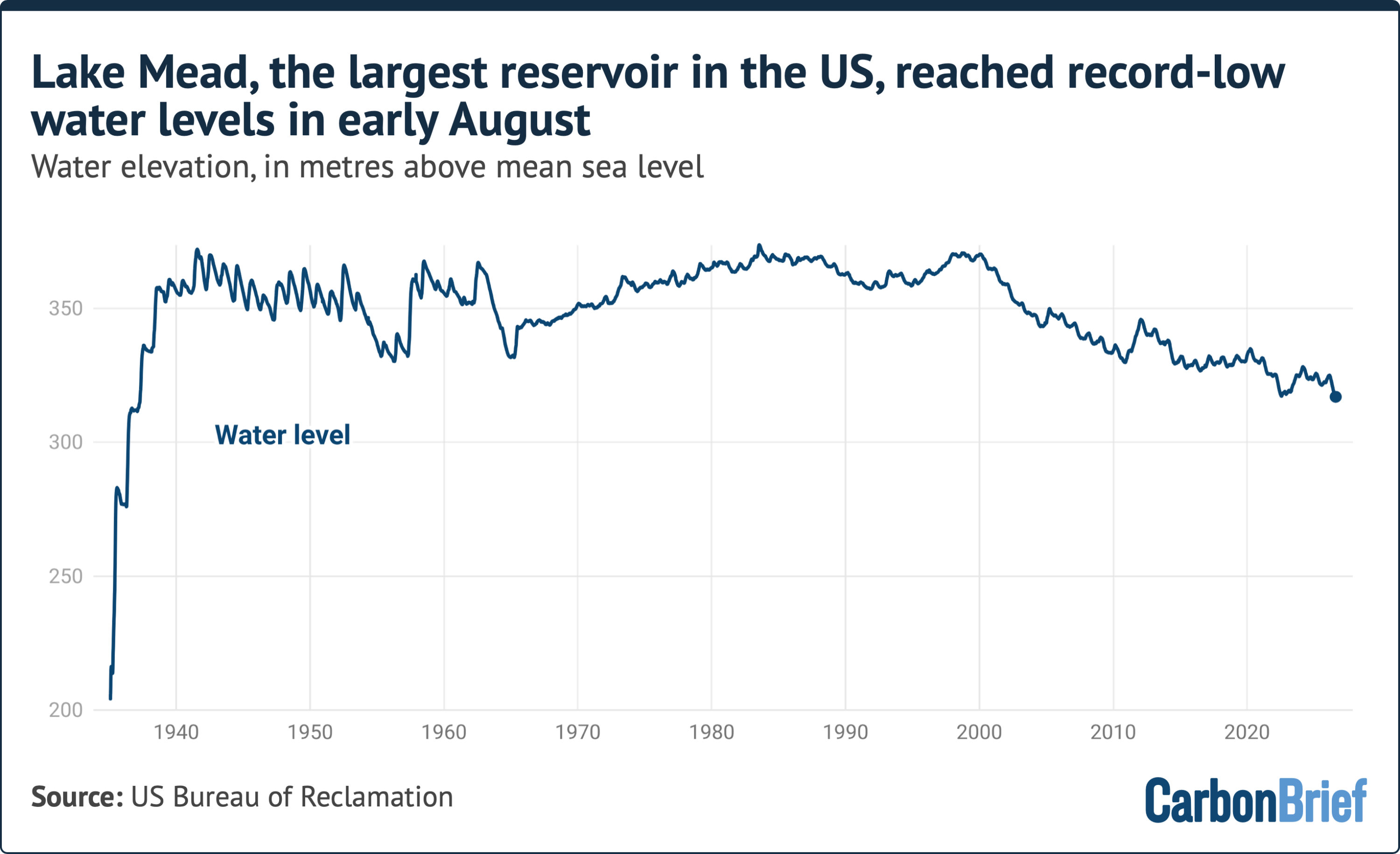
Lake Mead, the second-largest reservoir, recorded its lowest water height on Saturday, shortly after the largest reservoir, Lake Powell, broke its own record. Both are situated on the Colorado River. Experts attribute these record lows to a combination of climate change, population growth, and over-consumption.
At full capacity, Lakes Mead and Powell can collectively store 68 cubic kilometers of water. However, their water levels have been declining for decades. Lake Mead's water level reached a record low of 317.11 meters on August 7th, while Lake Powell's record low was recorded at 1,072.87 meters on August 15th. Both reservoirs continue to decline.
Dr. Jack Schmidt, a senior research scientist at Utah State University’s Center for Colorado River Studies, stated that the downward trend is expected to continue until the spring melt of the Upper Colorado River Basin snowpack. He highlighted the uncertainty of the upcoming winter and the certainty of depleting reservoir storage until approximately early April.
The current situation is exacerbated by several factors. Water flow in the Upper Colorado River has decreased by about 20% since the early 2000s, with climate change accounting for roughly half of this reduction. The majority of the river's flow originates from snowpack in the Upper Colorado River Basin.
The region has been experiencing a megadrought for over 25 years, with climate change contributing significantly to its intensity. Simultaneously, the growing population in the southwestern US has increased demand on the Colorado River's water supply, with the number of people relying on it for water growing by 60% since 1992.
Dr. Schmidt identified a warming climate as the ultimate cause of the water crisis, leading to decreased runoff in the Colorado River Basin. The proximate cause, he explained, is the slow pace of policy decisions in response to climate variability, often requiring intense political negotiation.
The US Bureau of Reclamation has released an environmental impact statement for its post-2026 strategy for managing Lakes Powell and Mead. While the statement suggests flexibility to reduce water delivery to states in response to crises, it acknowledges that this strategy may not be sufficient if critically dry conditions persist, which climate models predict for the 21st century.
AI-samenvatting op basis van de bron.
Carbon Brief